The Mubag Incorporates a Sorolla into its 19th Century Exhibition
The oil painting 'Garden of the Sorolla House' (1919) will be part of the exhibition for the next three years thanks to a private collector's loan.
Todo Alicante
Alicante
Wednesday, 19 November 2025, 18:35
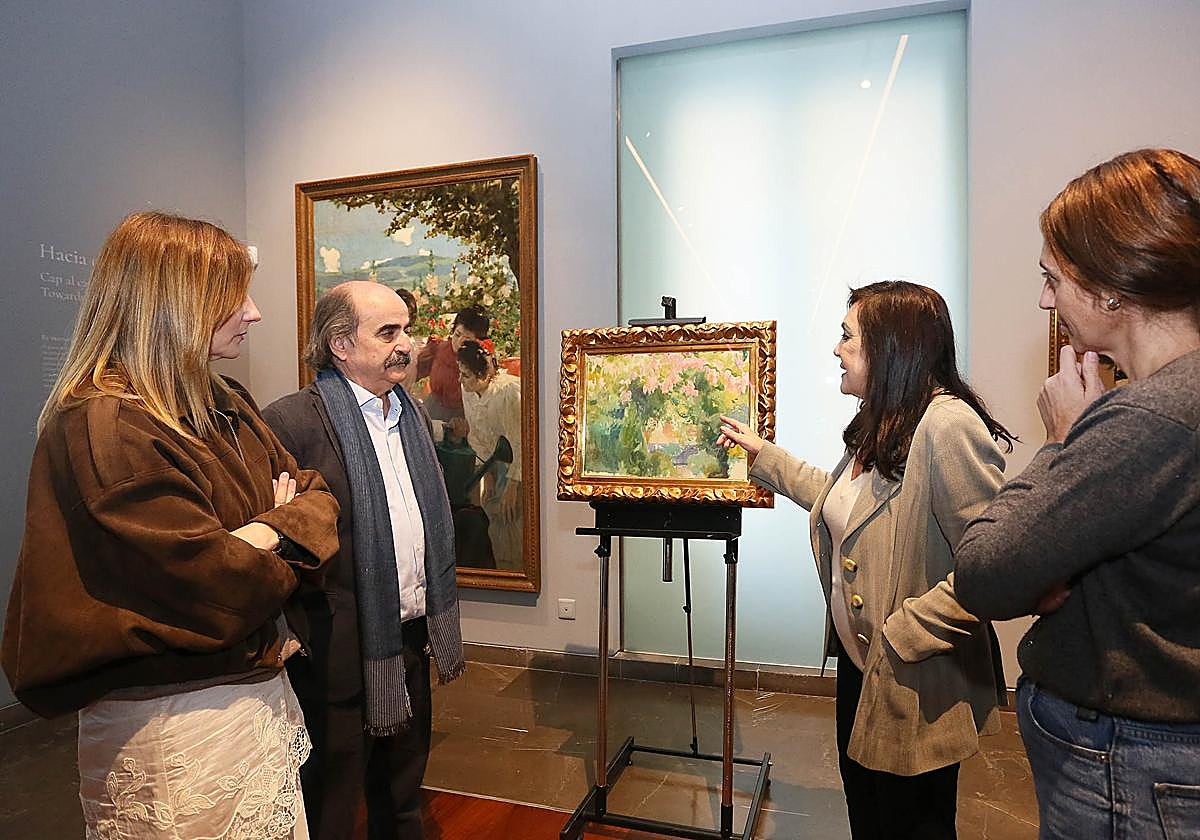
The Museo de Bellas Artes de Alicante (Mubag) unveiled this morning the artwork 'Garden of the Sorolla House' (1919), an oil painting by the Valencian artist that will be part of the permanent exhibition for the next three years, thanks to a private collector's loan.
The painting, previously displayed at the Museo de Po, is part of a series of gardens created between 1916 and 1920 by the artist, who painted every corner of his Madrid home's exterior with technical and expressive freedom, focusing on the light filtering through the vegetation, offering an explosion of colour. The intimate nature with which this work was conceived, one of the last in his prolific artistic career, grants it significant value among his vast body of work.
Related News
The MUBAG presents its new art window
The presentation featured speeches by Jorge A. Soler, director of Mubag, and Marisa Oropesa, representative of the lender, who wishes to remain anonymous. The Deputy of Culture, Juan de Dios Navarro, stated that this is "an exceptional addition that enriches our collection and allows us to continue fulfilling one of the main objectives of the Diputación, which is to bring culture and art closer to the public, providing opportunities to access the history and essence of our province."
An artist enamoured with the light of Alicante
Sorolla, a universal Spanish artist of the 19th century, followed the same path as most of his contemporaries: studying at the Royal Academy of Fine Arts of Valencia, receiving a scholarship from the Diputación de Valencia in Rome, and upon his return, settling in Madrid, where he participated in the National Exhibitions of Fine Arts. However, Sorolla achieved success at a young age, triumphing in exhibitions abroad with his social realism paintings.
Sorolla's figure is linked to the province of Alicante through various events. On several occasions, he acknowledged being greatly influenced by Emilio Sala, a pioneer in the treatment of light effects and colour contrasts, with whom he now shares space in the permanent exhibition.
The international triumph achieved at the Grand Prix de Paris in 1900 motivated him to create more personal paintings, seeking to enhance light with a more intense palette. The province of Alicante, specifically the sea of Jávea, was chosen as the setting to achieve his characteristic luminism.
Precisely, this luminism would influence artists from the province, such as Fernando Cabrera, a fellow student at the San Carlos Academy in Valencia, with whom he coincided in the artistic events of the time and alongside whom his work will be displayed.
In 1918, the artist moved to Alicante to create one of the panels dedicated to the Valencian region, part of a commission from The Hispanic Society of America in New York to decorate its headquarters. The chosen theme to represent Alicante was 'El Palmeral de Elche', which he completed in the capital, accompanied by two Alicante natives, his student in Madrid, Emilio Varela, and his contemporary Heliodoro Guillen.
His influence extends to subsequent generations of 20th-century Alicante artists such as Mataix Monllor, Vicente Albarranch, or Rigoberto Soler, among others. Sorolla will be the reference for capturing our Levantine light. As Soler explained, "the work 'Garden of the Sorolla House' is a clear example of the influence of his brushstroke, colour, and light treatment in his landscape on Alicante artists, making its integration into the museum crucial for understanding our 20th-century art."
Therefore, the painting fits perfectly into the final section of the permanent exhibition titled "Towards the Turn of the Century," which discusses the aesthetic shift towards a more modern treatment of light and a costumbrista painting style that opens up to the landscape, principles embodied in this work, which concludes the exhibition by opening the discourse to the contemporary works of the collection. Additionally, it is placed next to the portrait of Rafael Altamira Crevea, also by Sorolla, deposited last June for a year by the Museo Nacional del Prado.