"The Murder of Miguel Ángel Blanco Marked the Beginning of the End for ETA"
Basque journalist Ignacio Villameriel recalls the days of July 1997 that changed the history of the Basque Country in the novel 'Sargori'.
Álvaro Soto
Madrid
Friday, 8 November 2024, 12:03
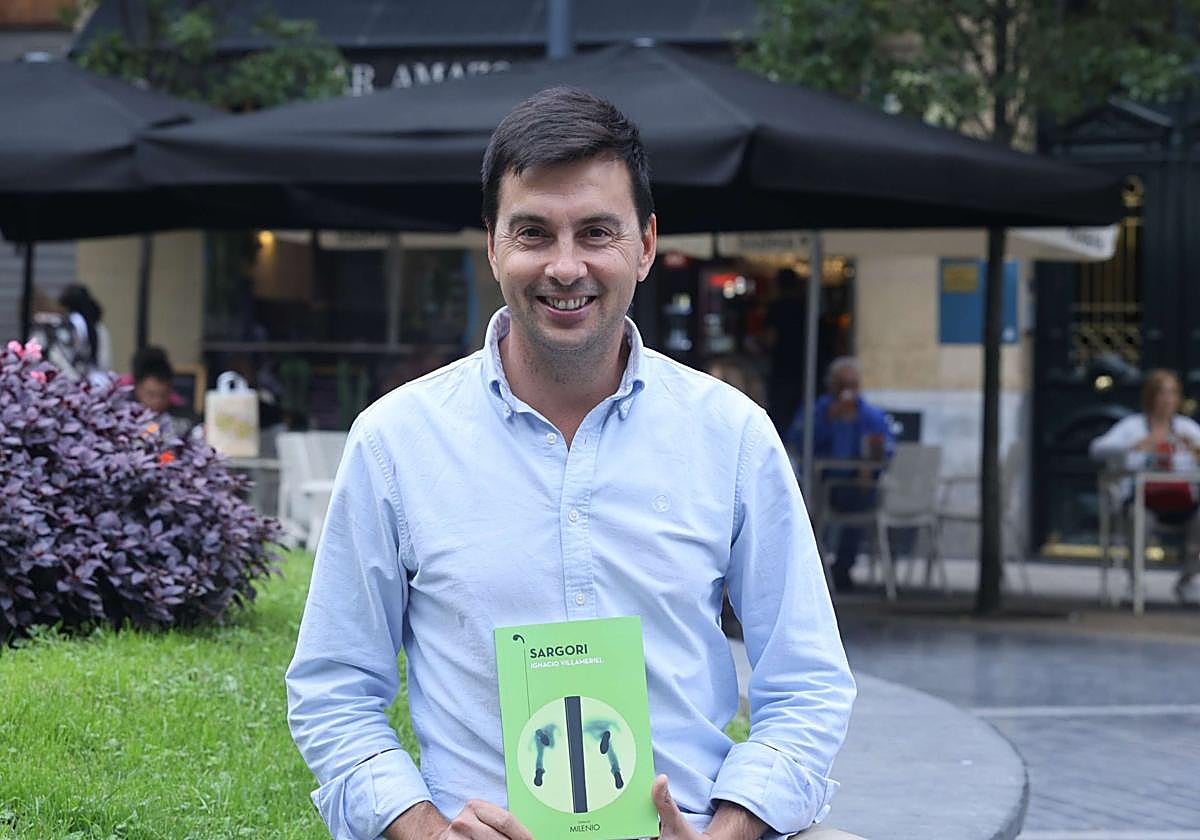
Like his entire generation, Basque journalist Ignacio Villameriel (San Sebastián, 1984) was deeply affected by the murder of Miguel Ángel Blanco. However, learning that a large majority of young Basques, 25 years after the crime against the PP councilor from Ermua, did not even know who Blanco was, led him to conceive a novel to remember those events. 'Sargori' (Milenio publishing house) is the fictionalized chronicle of those days in July 1997 when Basque society began to rebel against ETA through the experiences of a veteran journalist, his intern, and the intern's girlfriend. With 'Sargori', Villameriel publishes his third work following his two previous travel books, 'The Orange Arrow' and 'The Quixote Route'.
-Why did you choose July 1997 for your novel?
In the summer of 2022, I was rereading Tabucci's book 'Sostiene Pereira' and coincidentally, it was the 25th anniversary of Miguel Ángel Blanco's murder. The regional newspapers of Colpisa (I read it in Diario Vasco) launched a comprehensive special monograph on the anniversary with several very interesting reports. Among them, there was one that particularly caught my attention. It stated that a large majority of current university students had never heard of Miguel Ángel Blanco, and it occurred to me that his story could be told in a way similar to the Tabucci book I was reading. It only required changing interwar Lisbon for late 90s San Sebastián, with two journalists as protagonists. 'Sargori' tells the story of two journalists living in San Sebastián. Perales is a sixty-year-old who runs an independent press agency and is already thinking about his retirement. His existence is somewhat dull until, suddenly, one day Fran, who will be his intern during the turbulent summer of 1997, and his girlfriend María, appear in his life. The contact with the two young people revitalizes Perales, a character in continuous conflict with himself. The youth and drive of Fran and his girlfriend will make the veteran journalist reconsider his personal and professional life.
-Did things change forever after those days?
From my point of view, and without wanting to delve too much into politics, the kidnapping and subsequent murder of Miguel Ángel Blanco was the beginning of the end for ETA. It is true that it continued to carry out attacks for a few more years, but since that July of '97, it lost many of the supports that, by action or omission, it still had within a large part of Basque society. However, after carrying out the threat of Blanco's murder, society in general—not just the Basque—took to the streets en masse to show their rejection of terrorist violence without hesitation, and above all, without fear.
-What was Basque society like three decades ago?
Basque society three decades ago was, to a greater or lesser extent, constrained by fear. Many people were against ETA, but they did not dare to show it openly out of fear, cowardice, not wanting to seem less Basque, or for whatever reasons they might have had. In my case, I was still quite young, but it was evident that there were, on one side, the supporters who openly backed ETA, and on the other, the constitutionalists who risked their lives daily. And between them, a vast no man's land where people usually preferred not to stand out too much. This could be the case of the protagonist of this story, the veteran journalist Perales, who had always been characterized as a mere spectator who preferred not to get involved, but who finally decides to take a stand in the face of the gravity of the events.
-What role has journalism played in the so-called Basque conflict?
The journalists of that era, at least those covering political information outside the media close to the Basque left, were directly risking their lives. In many cases, they had to go with escorts, but I suppose that above all, they were guided by their journalistic vocation, not letting fear overcome them, to continue reporting what was happening.
-How is it possible that today's youth do not know who Miguel Ángel Blanco is?
That murder—and unfortunately, I had to live through quite a few from my early childhood to my youth—will never be forgotten. I remember it as vividly as if it were yesterday. I remember, for example, how journalists broke the news to Miguel Ángel's father outside his door as if I had seen it on the news this afternoon. And so, I clearly remember the sequence of that distressing weekend. That's why I was so surprised by the report I mentioned earlier. Moreover, to make matters worse, the university students they referred to were from the Criminology Degree, so it seemed even more shocking that they were not familiar with the subject. And, mind you, I don't say this with a vengeful vision, far from it. In fact, my intention has always been to write a book from a perspective of reconciliation.
-Has forgetting been the price to pay to coexist today?
That would have to be asked of the direct victims of ETA, but I understand that their answer would be more affirmative than negative. For my part, I have already said that my sole intention is to remember an event that seemed very serious to me, which I believe I will not forget as long as I live, and which I also believe should not be forgotten so lightly. I insist, not from a vengeful perspective, but from reconciliation.