“Misery Does Not Cause Revolutions; If It Did, They Would Be Much More Common”
British Historian Christopher Clark Explores the Revolutions of 1848, When Discontent Similar to Today's Was Brewing

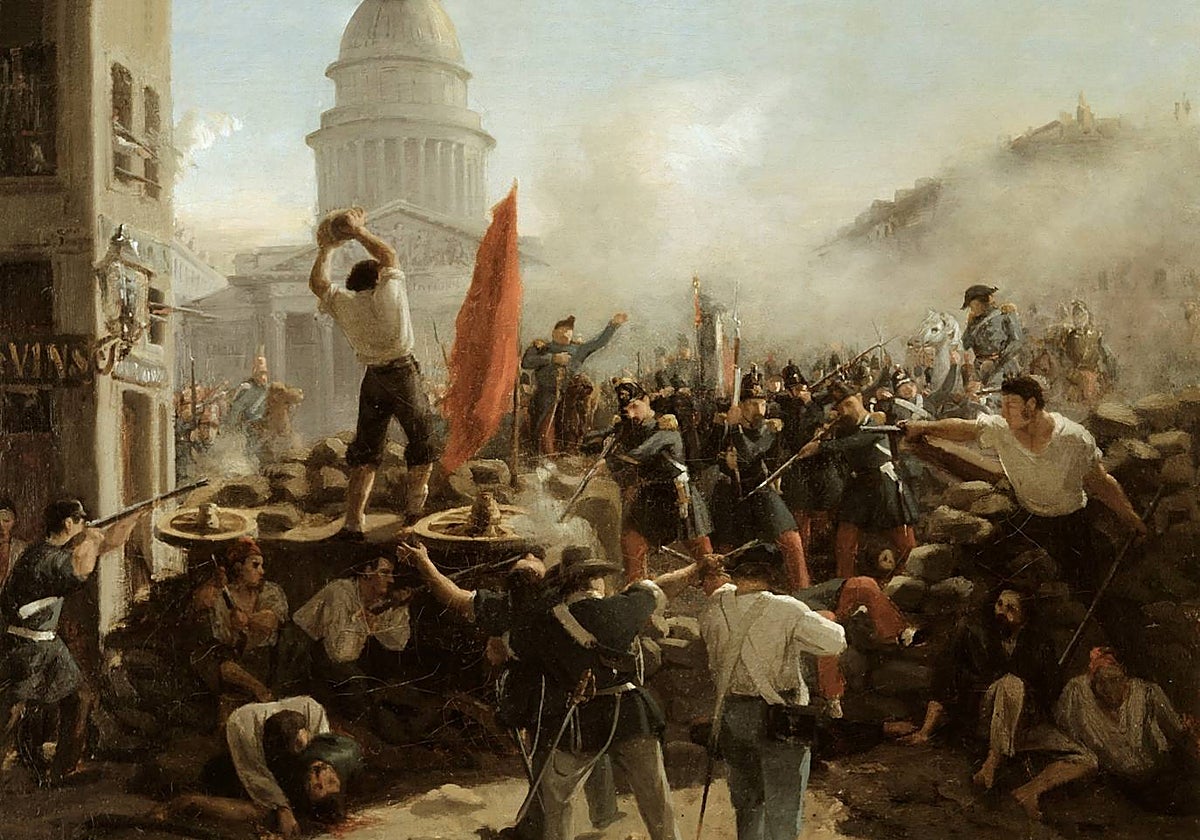
From Switzerland to Portugal, from Norway to Palermo, the revolutions of 1848 shook Europe like never before. Neither the French Revolution of 1789, the Paris Commune of 1870, nor the Bolshevik upheaval led to a comparable situation. Massive crowds, sometimes peaceful and sometimes violent, gathered in the streets and toppled the political order that had prevailed since Napoleon's defeat.
Christopher Clark, Professor of History at the University of Cambridge, narrates all these events in his book 'Revolutionary Spring: The Fight for a New World. 1848-1849' (Galaxia Gutenberg). Clark points out that the legacy of these revolts remains today, not only in constitutions but also in the styles and mentalities of both the left and the right.
In the wake of these uprisings, post-revolutionary conservatives learned to coexist with representative parliamentary systems and to use newspapers and mass movements to pursue their goals. “The left, which largely failed to secure its objectives in the revolutions, abandoned utopian and insurrectionist politics to embrace a broad program of social welfare measures that later became what we now call social democracy,” argues the British historian, author of 'The Sleepwalkers,' which has had a significant influence on determining the causes that led to World War I.
For Christopher Clark, the revolutions erupted during a time of growing social unrest, manifested in overcrowded workers' housing, significant child labor force, and the decline of religion among the poorest strata. However, the historian is adamant and doubts the role of discontent as a force for social mobilization. “Misery does not cause revolutions. If it did, they would be much more common.” According to the expert, mid-19th century saw leaders and newspapers emerge that were able to capitalize on the dissatisfaction of large masses demanding voting rights reform and protesting against corruption and excessive taxes.
Parallels
According to Clark, there are parallels between the discontent of those times and today's situation. The resurgence of social issues due to workers' impoverishment and overcrowded housing is one coincidence. “Another is the dissolution of the old political-party spectrum and the emergence of new protest movements that are difficult to place in terms of left versus right.”
Although revolutions in many countries followed one another rapidly, there was no domino effect where one outbreak triggered the next. Rather, all revolts were generated by a series of social and political conditions that spread across a continent interconnected economically and where similar cultural and political elements converged.
A debated issue then, such as "working-class poverty," continues to be one of today's hot topics in social policy. “And the relationship between capitalism and social inequality remains under scrutiny,” notes the historian.
Other results of those uprisings are many European constitutions. “The current Swiss constitutional system actually originated in 1848. The Danes still celebrate their constitution every year on June 5th in memory of its approval in June 1849. The constitution of the Kingdom of Piedmont, known as Statuto Albertino and sanctioned in March 1848, later became the constitution of the newly formed Italian monarchy.”
In just one year, Europe boiled over in a revolutionary spring followed by an autumn counter-revolution led by conservative forces aiming to quell uprisings and restore order. While revolutionaries were arrested, killed or went into exile, things never returned to how they were before.
“In general, the revolutions generated a transformation in European politics' content. Instead of the conflict-ridden politics of 1848, many European states adopted a technocratic style of governance aimed at moving beyond the conflicts of the 1840s and adopting instead a form of managerial administration based on technical expertise and statistical quantification,” explains Clark.
The reactionaries did not manage to abolish all freedoms, and several parliaments retained elections, freedom of press, and multiparty systems.