"This journey is not an escape, but a return to my happy years"
In 'Days of Sun and Stone', the writer pedals to Rome with pain as his baggage and Italian culture as his travel companion
Rosa Palo
Sunday, 26 October 2025, 00:10
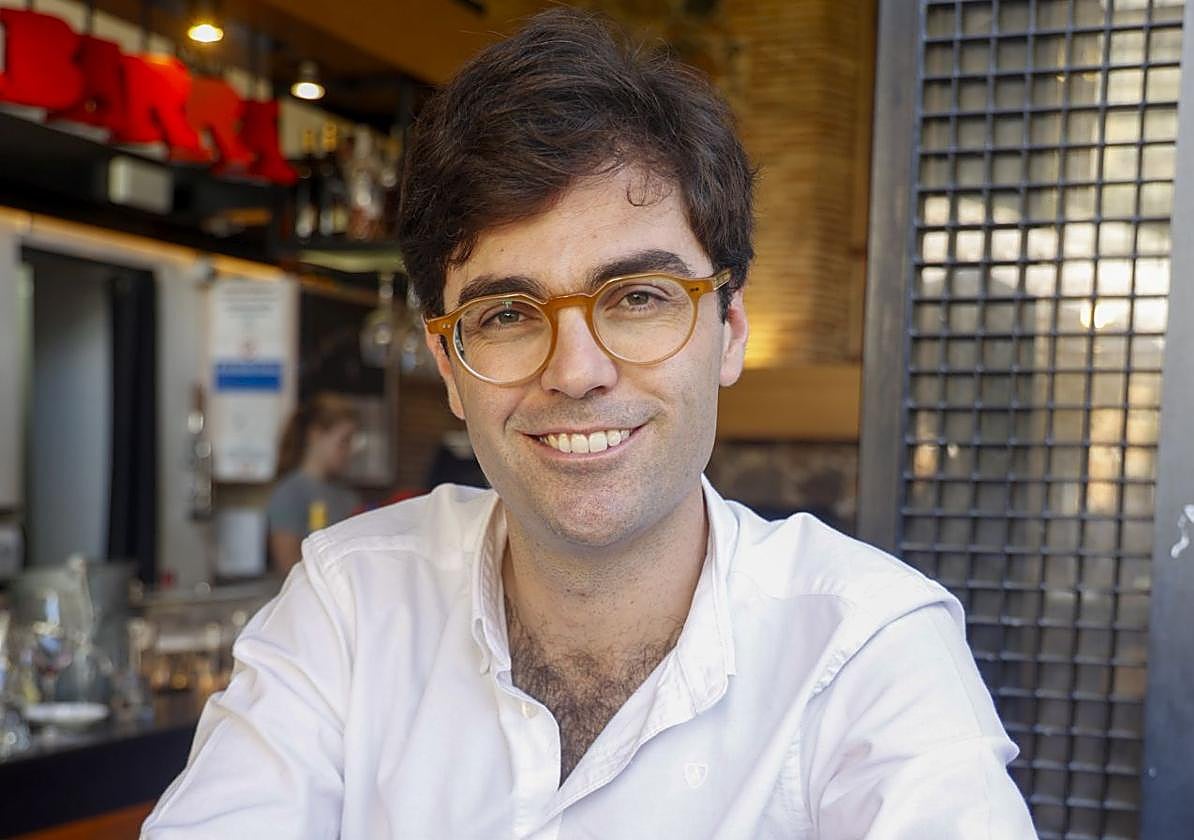
Philologist, art historian, and Literature professor in Seville, as a child he would travel in his mind while gazing at the pages of the atlas. Perhaps for this reason, and for all the journeys he has made around the world, it is unclear whether Pepe Pérez-Muelas is a writer who travels or a traveller who writes: when a life crisis strikes him deeply, bringing him to the brink of depression, he decides to confront it by packing his anxiety into his backpack and cycling along the Via Francigena, a pilgrimage route from the Alps to Rome. The result is 'Days of Sun and Stone' (Siruela), a work that intertwines intimate reflections with descriptions of the Italian landscape as he encounters Primo Levi, Pavese, or Petrarch. After reading the book, the doubt is resolved: Pérez-Muelas is a great writer who also travels.
-After so many kilometres on a bicycle, the vermouth must taste heavenly.
-Certainly. I had a sacred routine: I started pedalling at six in the morning to avoid the heat, and upon reaching the village at two, I would shower and enjoy an aperitif. In the afternoon, I would rest and write.
-You reveal yourself on the first page: "I have been afraid for months. Of death, of emptiness, of silence," you write.
-Yes. I am a very hypochondriac person, and in that process of extreme anxiety and hypochondria, I realise that I am not immortal, that I am no longer young. I start with some pains here, some pains there, and I find myself living in a world of pain that was all mental. And the pain is that one morning you wake up so dizzy that you can't take a step, and you don't even know why it's happening.
-This crisis drives you to make this journey.
-This journey is not an escape, but a demonstration that I can return to being my old self. It is a return to Italy, but also to my happy years, to the cheerful Pepe, who worked many hours but had time to be happy, to be with family.
-Why the Via Francigena?
-Because Rome marks the route. It is the city that has been my cultural and sentimental companion throughout my life.
-There are easier ways to get there than by bicycle.
-That has to do with anxiety. A friend, who had also struggled with it, said to me: "Hey, cycling helped me a lot, why don't you join me?" And so I did, and what was once rush and tension for me suddenly became relaxation. Being out of the city in twenty minutes and discovering the countryside, the mountains, the rivers, is extraordinary. I began to regain the ability to be amazed, and I don't want to lose it again.
-During the journey, you discover that you are not as solitary as you thought.
-I have experienced two different solitudes. One is that beautiful, dramatic solitude of nature: hearing the whisper of the forests, seeing the Alps... all of that is wonderful. But there is another solitude, and it is what I felt when, after making that great effort on the bicycle and arriving in a city, I couldn't share with anyone what was happening to me. That solitude is the bad one, the one I found on the road and couldn't escape. I realised that I don't like travelling alone, that I am nobody if I don't share with others what I feel.
-You stayed in convents and monasteries. Were you seeking faith?
-I haven't believed for many years, but I have a great spiritual vocation. I am an atheist who wants to believe, who embraces the Catholic religion with all its flaws and contradictions. On the first night, I have a conversation with Brother Stefano, who tells me that the important thing is not to believe or not believe, but to be a good person, and that if faith doesn't come to me, it's not that important. That is the religion I pursue, the one that allows debate, dissent. The one that does not despise intelligence.
-Did you have any setbacks?
-Yes, more than I mention in the book. I had a huge one crossing the Apennines, and I am very proud to have overcome it because it was entirely mental, not physical. That's when I understood that cycling is so beneficial for me because my mind went through the same process when I had anxiety attacks as when I felt incapable of climbing a mountain pass.
-Did you think about giving up?
-On the journey, no. In anxiety, yes. Fortunately, I have always had Mercedes, my wife, by my side. She is an extremely sensible person who has supported me.
-You are a lover of 'The Odyssey' who encounters a Penelope and a Nausicaa. Were they really named that?
-It is absolutely true. I met a Penelope, a very nice English girl, and a Nausicaa. This fulfils the theory that our lives aspire to be literary works, that life imitates literature.