These are the DGT car and motorcycle courses every driver should take
N. S.
Wednesday, 3 December 2025, 09:05
The DGT offers extensive training, including a series of specialised courses designed as a tool for continuous education. Any driver can voluntarily take these courses, and they should, to update their practical and theoretical knowledge and perform manoeuvres aimed at preventing accidents and reducing fuel consumption and emissions. Additionally, completing the course allows drivers to earn up to two points on their driving licence, provided they have a positive balance. However, the bonus will only be one point if they already have 14, and no bonus will be awarded if they already have the full 15 points.
It is Order INT/209/2025 that regulates these courses, which are divided into two types: for cars and motorcycles. In the latter case, two different modalities are offered: in urban environments (motorcycles and mopeds) and on conventional roads (motorcycles only). It is also stipulated that a maximum of one course of each type can be credited every two years.
This regulation outlines the design that the DGT has made for this new educational tool, "following the principles of defensive driving and leaving aside any type of manoeuvre associated with sports driving and risky practices," explains Montserrat Pérez, Deputy Director of Training and Road Education at the DGT.
Since its implementation, the DGT has launched courses in A Coruña, Cantabria, Granada, Málaga, Valencia, Madrid, and Zaragoza, and more than 330 drivers have already completed them. The training is comprehensive because, in the content scheme developed by the DGT, special importance is given to open road training, where students drive accompanied by the instructor and face real traffic situations such as roundabouts, intersections, lane changes, merges, overtaking, driving on ice, water, etc.
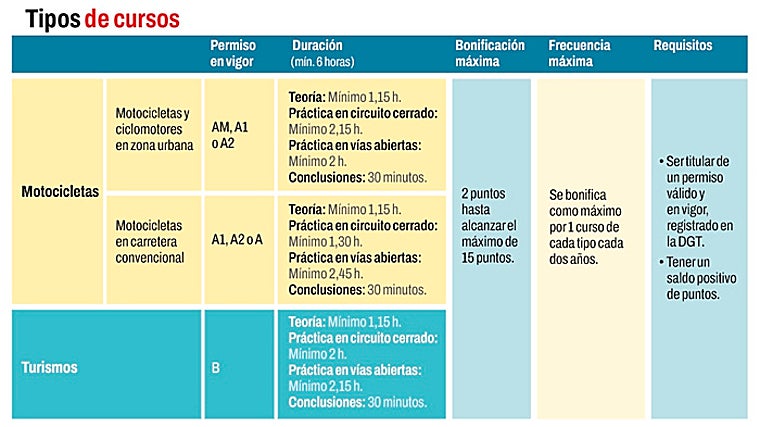
The mandatory content in closed circuits, both in courses for cars and motorcycles and mopeds, includes manoeuvres such as emergency braking and skill exercises, to know how to maintain a safe distance or to understand the difference in distance covered when driving at 50 km/h or 30 km/h.
The practice of these techniques is what most attracts those who have already participated in these classes, "especially regarding the safe distance, and the braking difference between 30 and 50 km/h, because they realise the risk they are taking," says Eduardo Colell, Director of the Educatrafic Foundation and CCSE instructor.
In any case, these are minimum mandatory contents, and centres can include other manoeuvres they deem appropriate, such as those pointed out by Aitor Vilaboy, a road trainer in the motorcycle and moped course in urban environments at the Gala Driving School in Madrid: "For example, techniques to fix the gaze, control the throttle, and tighter curves." Vilaboy emphasises the great acceptance this training has had: "If we held courses daily, we would fill them all. People from all over Spain are requesting them. From October, we will start with car courses."
Moreover, satisfaction with this initiative among those who have tried it is very high: "Most people believe they are a perfect driver, and they realise that is not the case. In fact, when they finish the course, they tell you that this should be part of every driver's mandatory training," says Colell.