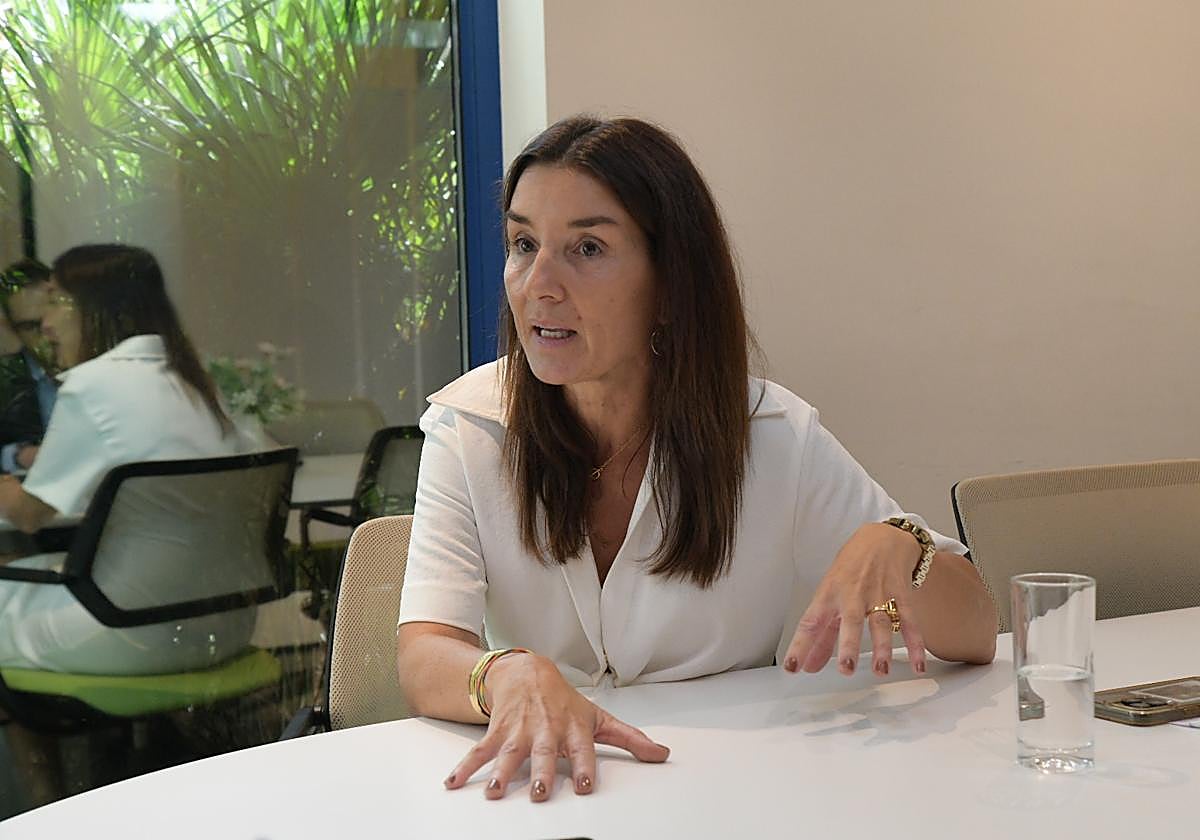
"Taxes Can Be Lowered and Revenue Increased; Citizens Should Not Pay Twice for Sánchez's Underfunding"
The regional treasury head defends the compatibility of tax cuts with economic control: "Social deductions have saved 20.6 million for Alicante residents."
José Carlos Martínez
Alicante
Sunday, 26 October 2025, 07:50
Ruth Merino is the keyholder of the Generalitat Valenciana's treasury. This is a significant responsibility given the management of one of Spain's most populous regions, which also suffers from a "chronic deficit" for "decades," as highlighted by the Minister of Finance and Economy in this interview with TodoAlicante. To add to the challenges, a meteorological disaster struck Valencia nearly a year ago, with tragic loss of human lives.
The damage from the storm has forced the Consell to undertake a substantial additional investment "from scratch," as the President of the Generalitat, Carlos Mazón, likes to say. All this amidst a strong commitment to administrative streamlining and tax deductions, which Merino, as the head of Finance, staunchly defends because "it works" and because "citizens should not pay twice for the underfunding by Pedro Sánchez's Government."
- How are the public finances of the Generalitat currently?
- Unfortunately, the Generalitat's finances have not been as they should be for decades. This year is no exception. We continue to suffer from the chronic deficit of the funding system, which results in receiving far fewer resources per adjusted inhabitant than the Spanish average. It is an injustice that we constantly demand the central Government address because it prevents offering the same services under equal conditions.
On the other hand, the efficient management we have applied since the beginning of the legislature is yielding results: resource optimization, administrative simplification, and tax cuts. All this has generated greater revenue. Nevertheless, treasury tensions persist, especially this year, due to not receiving the extraordinary FLA and having to resort to bank loans to pay suppliers.
- In the province of Alicante, there are significant projects underway that require sustained funding over several years, such as the City of Justice or the Central Station in the capital, to name two relevant examples. Is that multi-year funding guaranteed?
- Yes. These are large-scale projects with a firm commitment from the Consell. If liquidity from the FLA does not arrive, we resort to early management and banking collaboration to ensure payments. From day one, we have been committed to settling the historical debt with Alicante.
- How can planning and management be done without adequate funding?
- The previous regional Government inflated revenues and announced investments that were never realized. We have opted for realistic and rigorous budgets. The lack of funding forces us to incur deficits, but we have managed to reduce it by 1.3 billion in two years, from 3.8 billion in 2022 to 2.5 billion. It will continue to decrease in 2025. The deficit is not due to spending more, but to receiving less. The debt continues to grow, but at a slower pace thanks to more efficient management.
"The deficit is not due to spending more, but to receiving less. The debt continues to grow, but at a slower pace thanks to more efficient management."
Ruth Merino
Minister of Finance and Economy
- What role does the FLA currently play for the Valencian Community?
- The FLA was created in 2012 to provide liquidity to regions with treasury problems. It should be an extraordinary mechanism, but due to the lack of reform in the funding system, it has become essential. This year, the Spanish Government eliminated it without explanation. Fortunately, we anticipated this and secured bank financing to pay on time, but not thanks to the central Government, which ignored our requests for seven months.
- Are there hopes of finally achieving a new regional funding model?
- I do not lose hope, but past experiences do not inspire optimism. More than eleven years have passed since the system expired. If they finally present a proposal at the next Fiscal and Financial Policy Council, it will be positive, but we will have to see its content. Our position is clear: Valencians must be, at least, at the national average. All regions need more resources, but those historically treated the worst should have priority. I do not have much confidence in this Government, although I hope to be proven wrong.
"I don't think about reshuffles; my priority is to keep working 100% every day," she says about the upcoming Consell reshuffle.
- President Mazón has announced a Consell reshuffle for November 5th. Do you feel strong enough to continue in the regional Government?
- It was a planned reshuffle following the departure of Vice President Gan Pampols. I know there are rumours and speculations, but they do not concern me. My priority is to keep working at full capacity every day. I am grateful for the trust President Mazón has placed in me and focused on continuing to serve the citizens in the area I am most passionate about.
- One of the Consell's main focuses has been fiscal policy. What impact are the deductions having, especially in Alicante?
- I am often asked how we can lower taxes if we complain about lack of funding. The answer is clear: the citizens of the Community should not pay twice for the underfunding by Pedro Sánchez's Government. A good fiscal policy can increase revenue, as is happening: by September, revenues grew by 14% compared to the previous year.
In the province of Alicante, social deductions — for health, sports, or dependency — have resulted in a saving of 20.6 million euros in the 2024 tax return: 11.9 million for health and 8.7 for sports. It is proof that social policy can be done through taxation. In total, 203,000 deductions have been applied in the province of Alicante, benefiting more than 150,000 Alicante residents, with an average of about 100 euros per deduction.

- Is there room to expand these deductions?
- Yes. In the latest budget, we have included new deductions that double or triple the benefits for birth, adoption, or fostering. We have also launched deductions for those studying music or participating in bands, something deeply rooted in our Community. We will continue to expand these measures, which directly benefit families.
"A good fiscal policy can increase revenue, as is happening."
Ruth Merino
Minister of Finance and Economy
- It is almost a year since the storm, a devastating event in the Community and particularly in the province of Valencia. What is your assessment of the Consell's work to mitigate the disastrous effects it caused?
- First of all, we regret the human and material losses. From day one, we have worked on aid for affected families, vehicles, and homes, and on rebuilding infrastructure. We have doubled some aid, simplifying the procedures.
Without receiving non-repayable aid from the central Government, we have managed with the same human and financial resources both the ordinary and extraordinary budget for the storm. It has been a tremendous effort, but we are satisfied with the response provided.
- The management of the storm has also had a marked political component.
- It is a shame that an attempt was made to turn a tragedy into a political battle. While we were focused on reconstruction, the Spanish Government acted with partisan interests. Even so, we have not deviated from the essential: attending to the victims and managing effectively.
- Returning to the current Consell's management model, what progress has been made in administrative simplification and the reduction of political spending, two of the issues championed by the executive you are part of?
- We have eliminated duplications, reduced unnecessary spending, and improved administrative efficiency. In public procurement, minor contracts have been halved — from 30,000 to 15,000 — and ordinary contracts have increased tenfold, from 3,000 to 30,000. This implies more transparency, more control, and more responsible management of public money. The results are already noticeable, and we will continue to advance in this direction.
- How is the relationship with Vox now that it is out of the Consell? Do you trust that there will continue to be understanding to generate the political stability that Carlos Mazón's government needs?
- It has always been a relationship of dialogue and consensus. We are different parties, but we share many goals. Vox has shown responsibility by supporting the 2025 budget in a difficult time. We can talk and reach agreements. The important thing is the results, and these benefit the citizens.