The Real Madrid-Barcelona Rivalry Revitalised: 50 La Liga Clásicos of Youth and Experience
The average age of both Barcelona and Real Madrid has decreased by nearly five years over the past four years. This century's statistics reveal a complex reality.
Javier Varela
Friday, 24 October 2025, 07:36
For 90 minutes, the world of football will once again revolve around the rhythm of a ball and a historic duel: the Spanish clásico. Real Madrid and Barcelona, two clubs that transcend borders and symbols, will face each other this Sunday in the 50th La Liga clásico of the 21st century, a clash that measures not only points but also history, identity, and legacy. Since the 2000-2001 season, including the last match of the previous century, the scoreline has been almost poetic: 22 victories for Barcelona, 17 for Real Madrid, and 11 draws. Two decades of electrifying encounters have spanned stadiums, generations, and styles, always under the same premise. When the clásico is played, the world stops.
On the benches, history is also written with names that defined an era. Xabi Alonso, in his first La Liga season at the helm of Real Madrid, seeks to construct a new white narrative with the strategic rigour he displayed on the field. Opposite him, Hansi Flick, in his third league clásico, aims to consolidate a Barcelona that combines German precision with a youthful standard.
On the pitch, the shadows of Messi and Cristiano Ronaldo still linger, like echoes of an unrepeatable era. But the Santiago Bernabéu will witness a new dynasty in the making: Kylian Mbappé, the star who has brought a new dawn to the white house, arrives in top scoring form; facing him, Lamine Yamal, the prodigy who at 18 carries the hopes of a club that has always believed in talent as revolution.
The Galácticos Era of Madrid
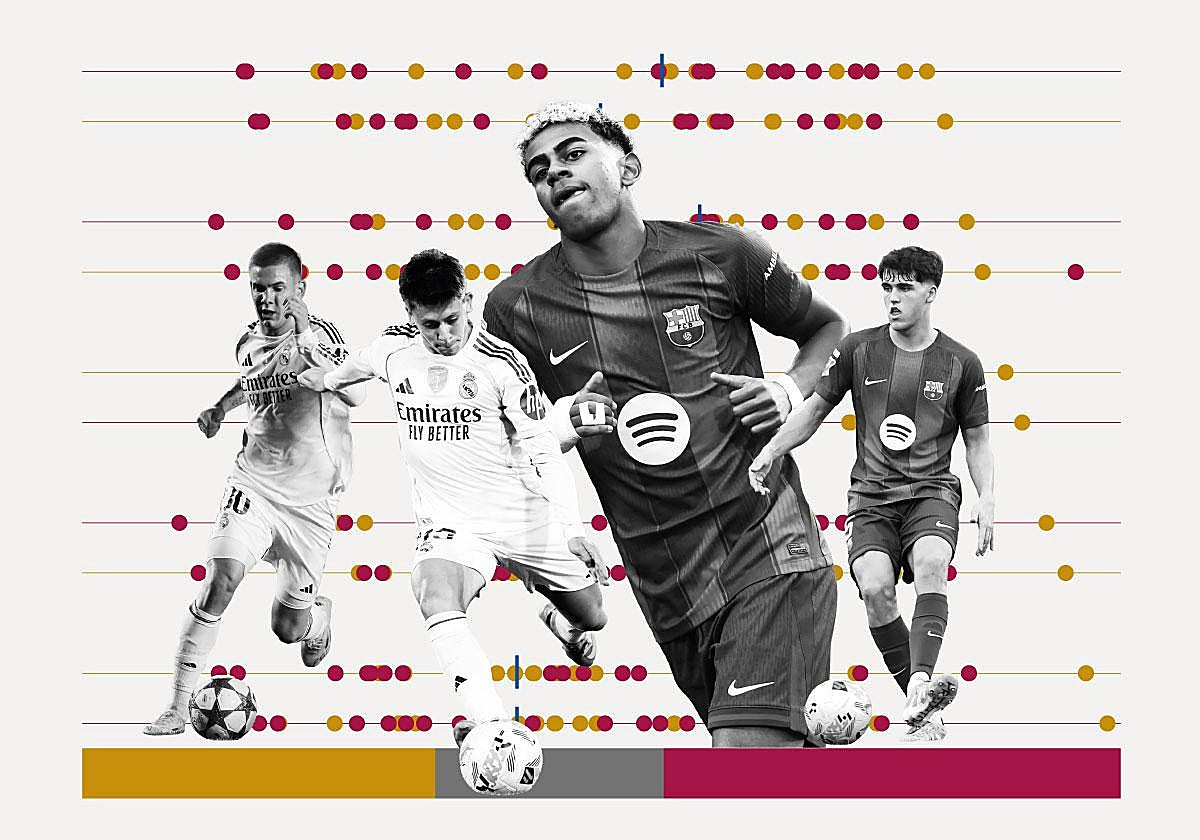
Barcelona, with median ages from 24 to 27, fielded a younger team in seven of the first ten clásicos since the 2000-2001 season. It was a youthful phase, marked by rebuilding, the academy, and young signings. Real Madrid maintained a higher median age (26–29 years), peaking with the 'galáctico' project. The white club symbolised experience and media brilliance, while Barça represented generational change.
Guardiola Rejuvenated Barça
Between 2005 and 2010, Barcelona transitioned from maturity to youth. Under Rijkaard, they peaked in 2006 (almost 30 years) but the cycle ended. With Guardiola from 2008, the age dropped to around 25 years: Messi and Busquets emerged, forming the base of the 2009 sextuple. Real Madrid maintained a high median age (27–29 years) and technical instability. Barça rejuvenated while Madrid bet on experience.
From Mourinho to Ancelotti
Both maintained similar median ages (25–28 years), though with opposite trajectories. Guardiola's Barcelona (2010–2012) was young, intense, and dominant, with players in their prime. From 2013, under Luis Enrique, the squad aged but achieved the 2015 treble. Real Madrid showed stability: young and powerful with Mourinho; balanced and mature with Ancelotti, achieving the Decima.
Precursor to Generational Change
Between 2015 and 2020, they experienced their most mature phase. Madrid maintained an average close to 29 years, with a veteran core (Ramos, Modrić, Kroos, and Cristiano), achieving three consecutive Champions Leagues. Barça, slightly younger (27 years), combined established figures -Messi, Suárez, and Piqué- with few replacements. It was an era of continuity and success for both before the generational change after 2020.
Barça, the Youngest in Europe
In the last five years, they have rejuvenated their squads. The average median of both dropped from over 29 to less than 25 years. Barcelona went from 29.4 years with Koeman to just 23.8 with Flick, betting on youngsters like Pedri, Gavi, or Lamine, becoming the youngest team in Europe. Madrid, more gradual, reduced its median from 28.9 to 25.7 years with Ancelotti, combining veterans and young talents like Bellingham or Vinícius.
AUX STEP FOR JS
Having a younger team, considering the starting eleven plus substitutions during the match, is not always synonymous with victory. When Barcelona fields a team with a median age two years younger than Real Madrid's, it does not stand out as much in its overall victory tally (eight wins, six draws, and six losses). However, when the median age difference exceeds two years in favour of Barcelona, meaning their squad is more experienced compared to the white team, the Catalan side almost always prevails on the scoreboard (six wins, two draws, and two losses).
In the case of Real Madrid, results do not depend as much on the age of their squads as on other factors. Whether in clásicos where they play with a median age two or more years higher than their rival, or when that gap narrows, the white team has achieved the same results (five wins, four losses, and one draw). Real Madrid, at least in this century, has shown that in these high-stakes matches, youth, often associated with energy and dynamism, does not guarantee better results. However, for Barcelona, experience and generational balance seem to be decisive factors in tipping the scales in their favour against their eternal rival.
Hansi Flick has set a new record in the history of clásicos between Barcelona and Real Madrid by fielding the youngest team of the century. The German coach, in the two league encounters he has led against the eternal rival, has opted for a starting eleven with a median age of just 23.8 years. His approach reflects his intention to build a long-term project and revitalise Barça's identity with promising players.
23.8 Years
Hansi Flick, in the two league clásicos he has managed, has opted for a starting eleven with a median age of just 23.8 years
On the other side, Real Madrid has also had its moment of renewal under the direction of Manuel Pellegrini, who fielded a team with a median age of 24.9 years, becoming the Madrid coach with the youngest squad in a clásico this century. However, he has only managed two league clásicos as the white team's manager, so, except for coaches with more matches under their belt, it is also a matter of adapting to the squad's talent rather than style.
Not everyone has followed this trend in favour of the young. At the opposite end are Gerardo 'Tata' Martino and Carlo Ancelotti. The Argentine fielded the most veteran team in a clásico of the 21st century, with a median age of 26.7 years, while the Italian coach came close with a squad of 26.5 years, favouring experience and stability over youth.
Luis Enrique stands out as the coach who achieved the best performance with Barcelona while managing a team with a median age below 26 years. His ability to enhance young talent and maintain a high competitive level places him as a benchmark in managing young squads. In contrast, Tito Vilanova and José Mourinho proved to be the most effective at the helm of teams with a median age above 26 years, leveraging the experience and maturity of their players to achieve notable results. This is known thanks to the ELO points at the date of the match, the chess-inspired metric that evaluates the team's level concerning the competition, the difficulty of the matches, and the opponents, among others.
26 Years
Tito Vilanova and José Mourinho proved to be the most effective in league clásicos with a median age above 26 years
On the other hand, Frank Rijkaard, Carles Rexach, and Fabio Capello did not achieve the same success with more veteran squads, highlighting difficulties in maintaining performance in experienced groups. Finally, Vanderlei Luxemburgo and Ronald Koeman rank among the coaches with the worst results when managing young teams, failing to exploit the potential of players with a median age below 26 years. These ELO metrics are not based solely on the players on the pitch for each clásico but on the trajectory of the entire squad before the encounter, helping to understand where Real Madrid and Barça stood when relying on their youngest line-ups or those with more experience.
The clásico is no longer just a match: it is a global liturgy, a work that reinvents itself every season. It brings together generations, styles, and dreams. This Sunday, Real Madrid and Barcelona will face off not just for three points, but for something greater: the eternal contest for the throne of Spanish football.