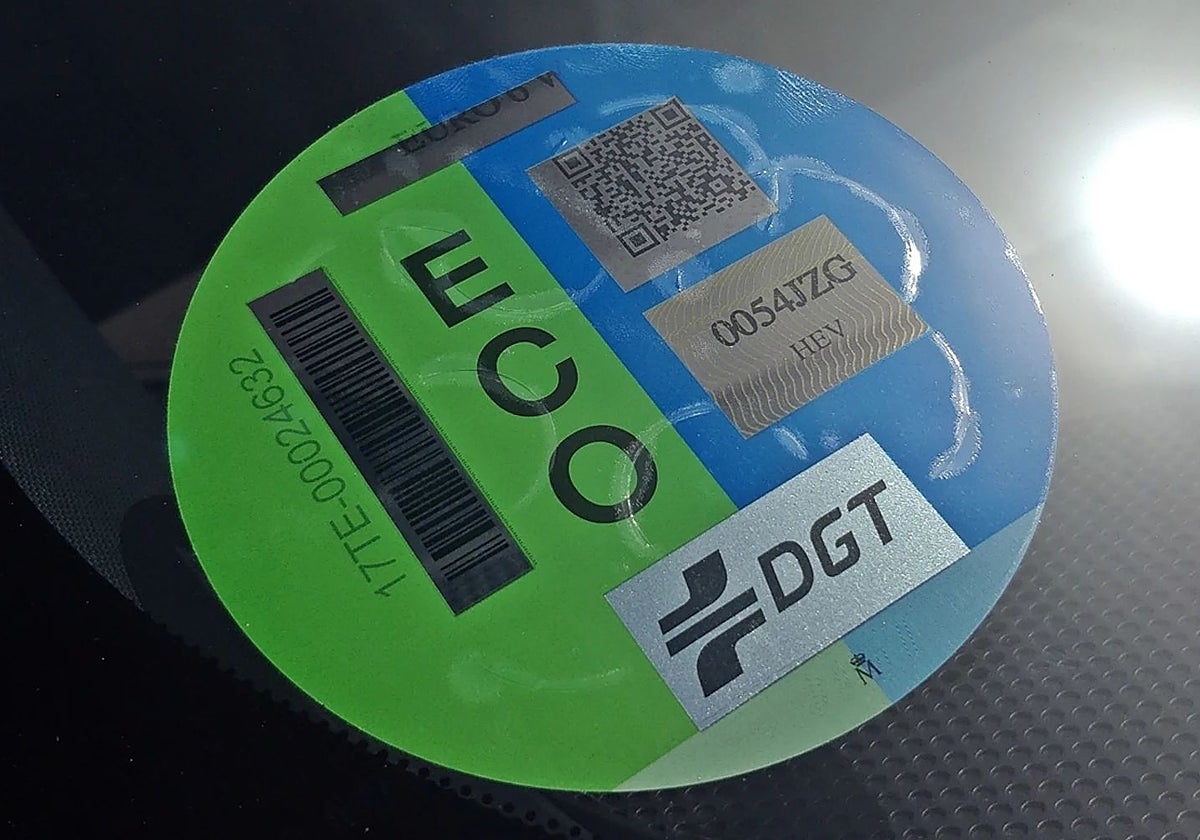
The Government Will Not Change Emission Labels, For Now
Juan Roig Valor
Thursday, 13 November 2025, 18:40
Today, the Spanish Congress of Deputies approved the Sustainable Mobility Law, which outlines the roadmap for transportation in Spain for the coming years. The text, which passed its final parliamentary hurdle with the support of the majority of the House, includes the mandate to develop a National Renewal Plan for the automotive fleet but excludes one of the most controversial provisions: the review of the current environmental labeling system of the Directorate General of Traffic (DGT).
The removed measure, initially proposed as the fifteenth additional provision, anticipated that the Government would conduct a study within 12 months on the advisability of updating the labels and including CO₂ emissions as an additional criterion.
The proposal was eliminated at the behest of the Popular Party, which justified the amendment for "technical reasons," and secured 179 votes in favor against 171 opposed. With its approval, the Executive is relieved of the obligation to review the current environmental labeling.
The main argument of the groups supporting the removal is the need to maintain regulatory stability during a transition to electric mobility. Supporters of the current system argue that a review could create confusion among buyers just as electric and plug-in hybrid vehicles gain ground and are expected to represent one in five cars sold by 2025.
Moreover, they recall that CO₂ emissions are already extensively regulated at both European and national levels. The registration tax, the hydrocarbon tax, the new European emissions trading system ETS2, and EU emissions approval standards all address this pollutant.
In fact, European regulations stipulate that from 2035, all new cars sold in the EU market must be zero-emission, representing the most significant regulatory intervention possible on CO₂ in the sector.
The Government had initially considered studying a review of the DGT's labeling system, designed to classify vehicles based on their impact on air quality.
Currently, the categories—from Zero to C label—are based on Euro standards, focused on measuring emissions of nitrogen oxides (NOx) and particulates, the main culprits of urban pollution and related health issues.
The discarded proposal aimed to incorporate CO₂ as an additional parameter, despite this gas not directly affecting human health but contributing to global warming.
This distinction has been crucial in justifying the Congress's decision, which believes the labels should continue to reflect the impact of vehicles on air quality rather than on the climate.
The debate over environmental labels had been ongoing within the Government itself for years. The DGT advocated for an update to correct distortions in the current system, which grants the Zero label to plug-in hybrids with more than 40 kilometers of range—even though they emit much more in practice than homologation tests indicate—and the Eco label to high-powered gas or mild hybrid models. However, manufacturers feared that an immediate change would stall sales and increase technological uncertainty.
With the approval of the Sustainable Mobility Law, the review process is, for now, on hold. However, the Executive retains the possibility of addressing a change in the system later within another regulation or through a specific reform.
Meanwhile, the Government must focus on fulfilling the other major mandate of the law: the development of a National Renewal Plan to encourage the replacement of older vehicles with low or zero-emission ones, a measure long demanded by the automotive sector.