Exclusive World Premiere: Testing the New Kymco CV3 575, the Most Powerful Three-Wheeled Scooter on the Market
IVÁN BOLAÑO DOFORNO
Wednesday, 22 October 2025, 16:41
Kymco unveiled a three-wheeled concept at the Milan show in 2017 that generated much anticipation. The Taiwanese manufacturer, already seated at the table with the major scooter brands for years, decided to match the best from a technological standpoint and began developing its most powerful engine and a technical team around it to offer premium standards of sportiness. That same year, the AK550 was launched, the model chosen to compete with the Yamaha TMax, debuting this new technology and top-tier components from the Taiwanese firm.
Meanwhile, Kymco continued developing its tricycle with the same twin-cylinder base as its "brother" maxiscooter but with its own chassis specifications and, of course, front-end train, aiming to refine a product designed to face the segment leader, the Piaggio MP3. Finally, in 2022, the CV3 (Crossover Vehicle 3) was ready, but its commercialization only began in some European countries like France, Germany, or the Netherlands, where more than 5,000 units were sold. Kymco Spain's officials preferred to wait a little longer...
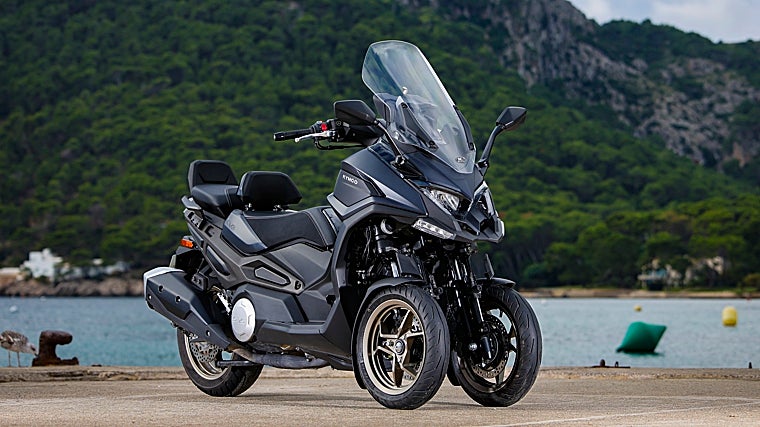
"Spain is a demanding market," explained Carlos Wang, general manager of the Spanish subsidiary. "We were clear that our first three-wheeled scooter proposal had to offer a leap in power, performance, and sensations. This led us to work closely with the factory for a while on a second generation," added the executive.
No motorcycle license needed
This second version of the CV3 is ready, and Spain has become the first country in the world to market it. It will arrive at dealerships starting this November at a competitive price of €11,950 and will be a model that can be driven with the A motorcycle license but also with the B car license, from the age of 21 (as it meets technical conditions that homologate it in the L5e tricycle category).

The brand itself defines it as a product aimed at car customers who want to switch to motorcycles but prefer the safety of three wheels. At the same time, as we could verify during the presentation we attended this week in Mallorca, testing the CV3 on a route of about 150 km, it is a vehicle with certain fun touches thanks to a strong acceleration capacity and a sufficiently stable dynamism for experienced handlebar users to consider the Kymco a comfortable alternative for enjoying a winding road or planning a trip with a partner.
High-end
The CV3 is presented as a premium three-wheeled megascooter that offers a high level of equipment and technology, including a 7-inch full-color TFT screen with a variety of menus selectable comfortably from the handlebar controls, full LED lighting, three-level heated grips, USB type C socket in the center of the handlebar, adjustable levers, or keyless proximity key (maximum range of 3.5 meters, with automatic shutdown system, which turns off the bike 20 seconds after leaving the range).
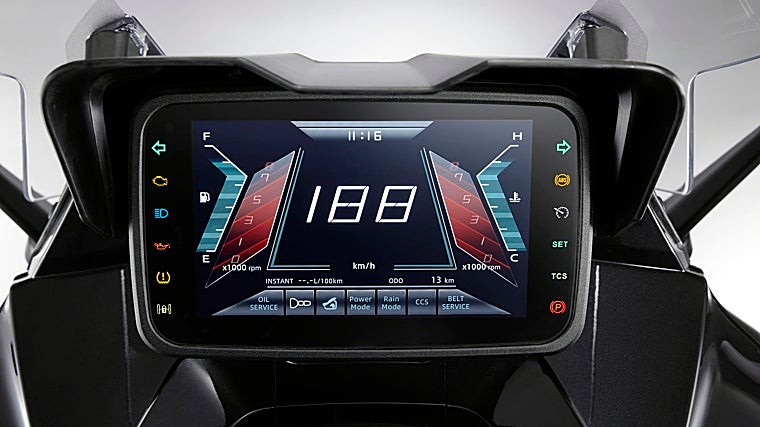
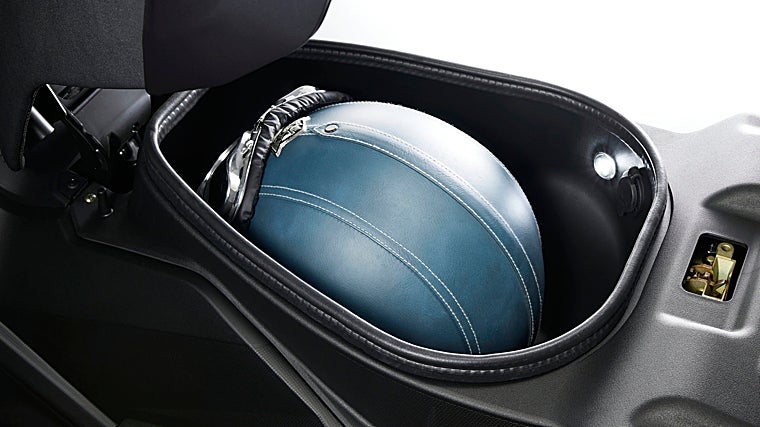
Regarding electronic aids, we find cruise control (activatable between 45 and 130 km/h, the button varies by 2 km/h), disconnectable traction control, and driving modes. In terms of comfort, its ergonomic seat with an adjustable backrest in 4 positions for the rider helps, and, in terms of storage capacity, the CV3 offers a space under the seat sufficient to store a full-face helmet, where we find interior lighting and a 12 V socket. In the central console, we have a multifunction control panel, with 4 buttons that allow quick access to various functions: seat opening, access to secondary menus, trip information, and steering lock. The bodywork is marketed in two colors, white and black.
The most powerful engine in the category
The heart of the CV3 575 (already Euro 5+) comes from Kymco's flagship sports model, the AK550, a choice that, of course, clearly marks its intentions: to become the most powerful model in its segment. It is the exclusive sealed engine patented by the Taiwanese brand, with an inline twin-cylinder configuration, 4-stroke, DOHC distribution with 8 valves, and a 270º crankshaft, powered by electronic injection and liquid cooling.
For this generation, its displacement has increased - from 550 to 574 cc - offering a power of 51 hp (previously 50.3 hp) and a torque of 54.4 Nm (previously 52.3 Nm). These are not significant increases, but they are enough to give the CV3, a vehicle weighing 287 kg in running order, a more solvent delivery at low and medium revs that could counteract the nearly 50 kg increase on the scale compared to the AK.
It offers two driving modes, Power and Rain, which do not alter the maximum power but do modify its response: maximum power for normal dry conditions, or a gentler acceleration for slippery surfaces.
The brand establishes an official consumption of 4.6 liters per 100 km, being able to reach a range of up to 330 km with a single tank of gasoline.
Chassis and suspensions
The structural core of the CV3 consists of a double-beam aluminum frame and an alloy subframe, the latter with a monocoque double-beam structure and exposed as part of the bodywork, one of the vehicle's design identity features. Kymco has put a lot of effort into developing a skeleton that would provide the set with lightness and rigidity: the weight is only 15.3 kg, which is distributed almost equally, that is, 7.6 kg for the front chassis and 7.7 kg for the rear subframe, something unheard of in its segment and a key aspect for the CV3 to offer balanced dynamism.

But the "life of the party" is found in the front train, where the KALS (Kymco Advanced Leaning Suspension) system, patented by the brand itself, is located, allowing the CV3's two front wheels to tilt (up to a maximum of 40 degrees) and work together with stability and quite naturally. The system employs a pair of 37 mm thick forks with 98 mm of travel, one for each front wheel, which are connected by a deformable parallelogram with 4 alloy arms and 6 linkage points.
The system also features the electronic lock function of the tilt and suspension: via a button on the right handlebar grip, the user can lock the front train so that the CV3 remains rigid (as long as it is driven below 2,000 rpm or 3 km/h), so the user does not have to put their feet on the ground. The system is manually unlocked on the same button or automatically, once we accelerate and exceed 2,200 rpm or 2 km/h. It is a convenient solution for moments when stopping at a traffic light or when we want to get on and off the vehicle.
At the rear, a shock absorber with a 42 mm travel and an almost horizontal position, unusual in the segment, works. The braking is handled by a disc brake system on all three wheels assisted by ABS, with a double front disc of 250 mm and a rear of 260 mm, with double-piston calipers and metal hoses. It also features a parking brake and pedal brake (CBS). The front wheels are 13 inches, while the rear is 15, all fitted with Maxxis tires specifically developed for this model, in sizes 110/70 front and 160/60 rear.
Tested in the Tramontana Mountains
Paris or Milan are clear examples of cities where three-wheeled scooters have historically fit in. Their uneven pavements and adverse weather conditions for many months of the year have been factors encouraging many urban users to opt for scooters that, in addition to offering comfort and protection, have the safety plus offered by that pair of front tires. In Spain, Madrid or other cities in the north of the peninsula could be good places for a CV3 that also arrives to convince car drivers tired of traffic jams but not convinced to get on a conventional motorcycle, finding in this model a safe and high-performance alternative.
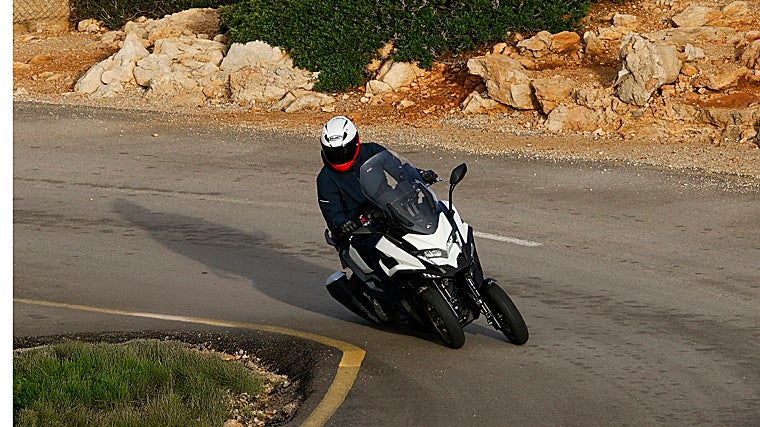
But in addition to having the usual qualities to handle day-to-day life (the convenience of automatic transmission, storage capacity, good protection, and comfortable posture...), the Taiwanese proposes other characteristics that mainly show a more touristy and even sporty side. Its bodywork is voluminous, no doubt. With dimensions of 2,140 mm in length, 800 mm in width, and 1,485 mm in height, and a weight of 287 kg, we are dealing with a somewhat stubborn vehicle to move when stationary. So no trying to move it while sitting on it, unless you have the quadriceps of a bodybuilder. Better off the vehicle, pushing forward or backward with the steering lock activated, is the best option. It is wide in the central area, but its tunnel is not very high, and passing the leg over to sit is not complicated. The seat height is 780 mm.
On board, very comfortable. The seat accommodates the driver well, who has an adjustable lumbar backrest. The foot platforms are sufficient without being spacious. On the right, we find the classic mandatory pedal on tricycles, which takes away some space to place the foot. And the passenger is also well received, with a large separate seat, foldable metal footrests, and a lumbar backrest.
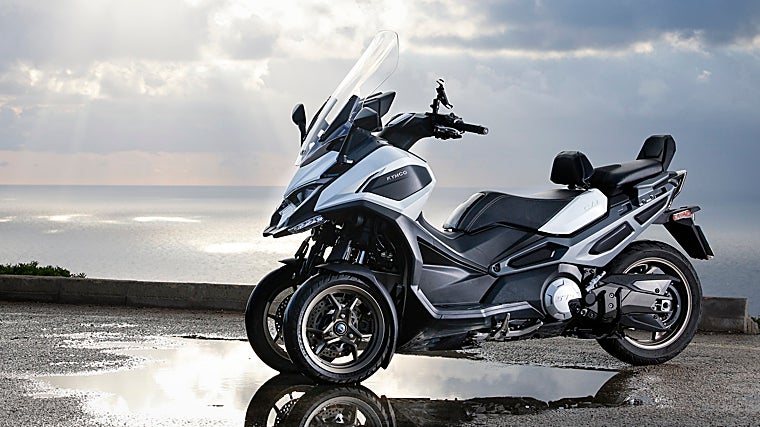
For the cabin, it seemed to me a very capable megascooter to face a trip, with a relaxed posture and well protected, as the windshield is wide and covers quite a bit (it adjusts in two positions, with a 4 cm difference, but not manually, tools are required), and the vehicle's large front bodywork is quite enveloping, and the legs and torso are sheltered. It has electronic services that complete the experience, such as cruise control or driving modes, all operable from the left handlebar control.
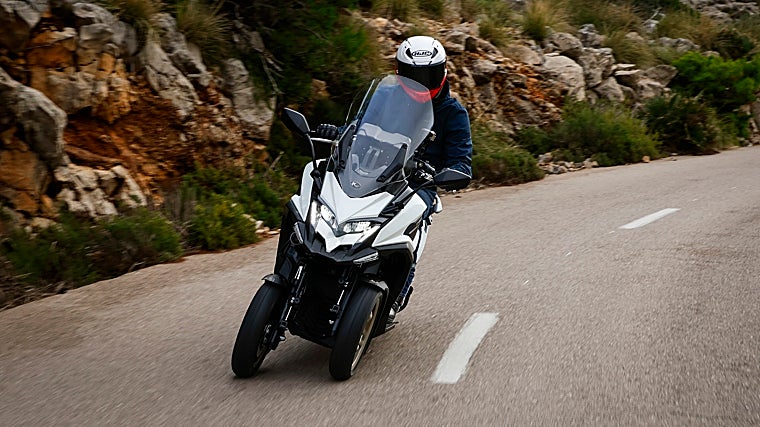
The sporty character Kymco alludes to emanates mainly from its engine, its best argument, a 51 hp engine that offers the best performance in its segment. It accelerates very forcefully, offering leonine lows and mids, and is very progressive, maintaining that vigor towards the high zone, with good stretches. The top speed is around 170 km/h. And despite that weight close to 300 kilos, this beast is quite lively. The front train supports with great firmness and stability, and direction changes are agile.
The engine is positioned quite low (lubricates by dry sump), which lowers the center of gravity and favors the vehicle's maneuverability. This engine serves as a structure, is self-supporting, minimizing unsprung masses, supporting efforts and torsions well, and ultimately achieving good maneuverability, docility, and good dynamic behavior. The 50/50 weight distribution, a rarity among scooters, favors very balanced driving.
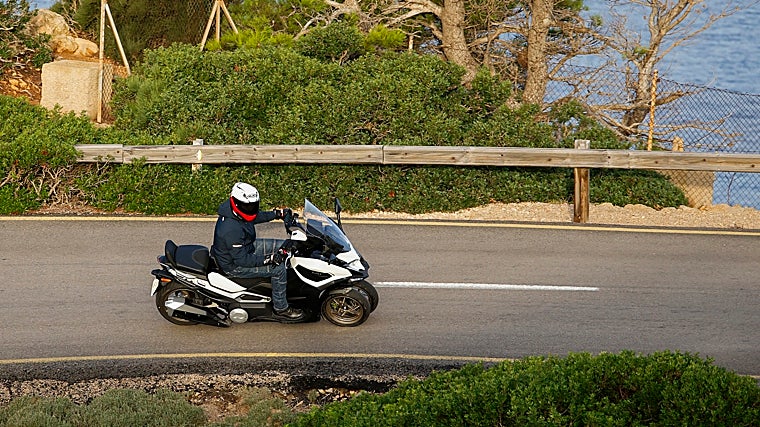
Personally, I liked the poise with which the front train works, with a fairly natural trajectory and maintaining stability at all times. It's not that I had the same feeling of riding a conventional motorcycle, after all, you have two tires in front that must synchronize well, and in the case of the Kymco, the result is optimal. The mechanism does not generate oddities, and as the kilometers pass, one gets used to a nuanced ride, but it gives confidence. Linking curves, you have to be a bit more interventionist on the CV3's handlebar to keep the trajectory, and help it a bit more than usual, compared to a conventional motorcycle obviously, to sway from one side to the other. The KALS makes the suspension, tilt, and steering systems independent, a solution that avoids the effect of the bike lifting when leaning. The suspension does its job without affecting the trajectory or steering.
On the other hand, in the braking phase, a system that offers good feel, you have to be authoritative with both levers, especially when enjoying a more sporty ride, to contain its high performance.
In short, with the new CV3 575, Kymco presents a very ambitious new alternative in the tricycle segment, with an outstanding engine capable of pushing the vehicle with force and offering truly exciting acceleration sensations, and with equipment and comfort that faces not only urban journeys but also longer trips, even with a partner. In our opinion, the bite of the front brakes could be improved, which in sporty driving may seem insufficient, especially because the vehicle runs quite fast and weighs a lot. The grip of the front tires in the wet would also be another aspect to improve. Otherwise, a complete megascooter, well finished, with surprisingly poised behavior and complete equipment. In addition, its price is really competitive. Kymco Spain's own officials have confirmed that, despite the fact that in this second generation they have tried to refine and polish the CV3 to offer superior performance while maintaining the level of finishes and technology at all times, it has been decided to position it below 12,000 euros, a purely internal decision of the management in Spain, to give it a competitive edge in its segment.