Clandestine Laboratory in Sax Dismantled: Colombian Network Extracted Cocaine from Imported Fruit Pulp
The National Police, along with Customs and the Colombian National Police, have arrested eleven individuals. 27 tonnes of fruit pulp have been seized following the interception of a shipment destined for Spain in South America containing 955 kilos of cocaine hidden in this vegetable substance.
Óscar Bartual Bardisa
Alicante
Tuesday, 11 November 2025, 14:20
In a large-scale operation, the National Police, in collaboration with Customs and the Colombian National Police, successfully dismantled a clandestine laboratory located on a Sax estate. Here, a Colombian network was extracting cocaine from shipments mixed with fruit pulp. The criminal organisation had established a commercial entity in Spain to import the shipments and possessed a significant amount of precursors to extract the drug. The operation resulted in eleven arrests.
The drug trafficking network was uncovered after a container bound for Spain was intercepted in Colombia, carrying 955 kilos of fruit pulp altered with cocaine. An identical shipment was captured days later in Monóvar, this time with 27 tonnes of fruit pulp not yet contaminated with the drug, according to police sources.

The investigation began in 2024 after detecting imports of this vegetable material originating from Colombia and destined for an Alicante company. There were suspicions that these shipments might contain drugs. Investigators began inquiries to determine the real destination of these packages and locate the clandestine laboratory where the cocaine was extracted.
During the first phase of the investigation, which involved documentary control of the imports, investigators identified the three main suspects, one of whom was the leader of the operation, making all decisions without leaving a documentary trace. The other two were listed as company partners and organised all the logistics of the importation.
In a second phase, the arrival of a new container was detected in May 2025. This time, investigators monitored the goods, which were unloaded in a warehouse linked to the importing company. The criminal network employed sophisticated logistics designed to avoid traceability. They used vehicles registered under third-party names, both with and without criminal records, and unrelated to the company. This was complemented by using proxy drivers and counter-surveillance procedures, such as evasive routes, night-time schedules, or distraction manoeuvres.
Thus, the organisation created an intermediate layer between the commercial entity receiving the goods and the locations where the drug was actually manipulated, complicating the legal identification of possession and effective control over the narcotic.
New shipment exposes criminal network
Despite all these advanced measures, agents identified new individuals involved in the operation and located a site that met all the requirements to set up a clandestine cocaine extraction laboratory. Following these findings, last September, authorities detected a new container of fruit pulp in Colombia. After extracting samples, South American agents confirmed it contained 955.5 kilos of cocaine impregnated in the fruit pulp.
These findings gave the green light to the operation that would dismantle this drug trafficking network. The operation took place on November 4th and 5th, resulting in five raids and searches in Sax, Elda, Monóvar, Petrer, and Castalla, and eleven arrests.

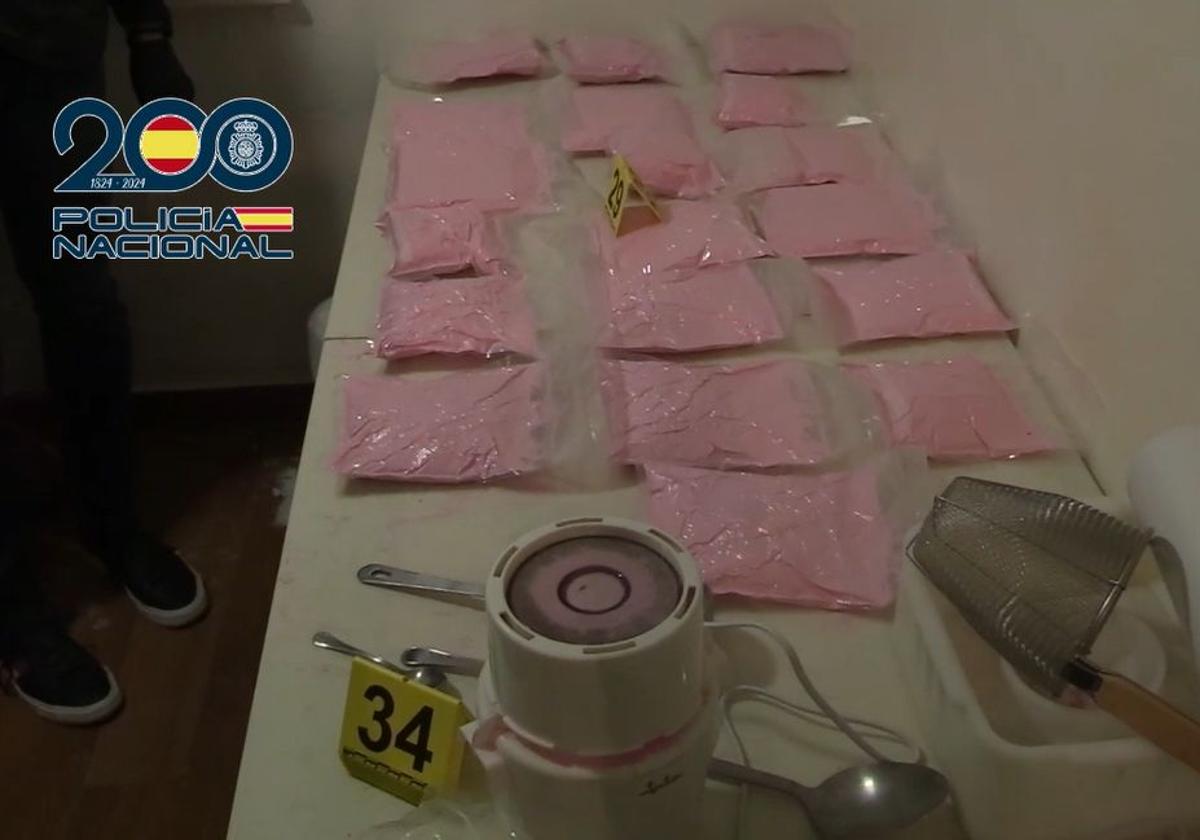
During the search of the clandestine laboratory, located on a Sax estate, more than 1,000 kilos of precursors and other substances used in the extraction and production of cocaine were found, along with pots, drums, sieving paper, scales, and test tubes. Additionally, 10 kilos of cocaine and remnants of an indoor marijuana plantation with 2,330 grams of the substance ready for consumption were discovered.
Regarding the warehouse rented by the commercial entity, agents discovered 27 tonnes of fruit pulp, although subsequent analyses revealed it was not contaminated with drug traces. It was distributed in 65 metal drums of 200 kilos and 1,216 boxes with 24 packages of 500 grams each.
In the rest of the searches, three vehicles, numerous electronic devices, documentation, and cash were seized, along with a banknote counting machine. The detainees, after police proceedings, have been brought before the magistrates' courts of Alicante, Elda, and Novelda.