Ena, the 'British' Queen Who Modernised the Spanish Crown
From her wedding with an attack to exile, a grand exhibition traverses the tumultuous life of Victoria Eugenia of Battenberg
Miguel Lorenci
Monday, 1 December 2025, 17:45
From a modest place in the folds of history to being recognised as a star: the great moderniser of the Spanish crown. This is the final journey of María Eugenia de Battenberg (1887-1969), wife of Alfonso XIII, mother of Juan de Borbón, grandmother of Juan Carlos I, and great-grandmother of Felipe VI. The Gallery of the Royal Collections dedicates a spectacular exhibition to her, coinciding with the premiere of the series Ena - as her family called her - on TVE. She was the last queen to reside in the Royal Palace of Madrid, from which she departed in 1931 with the advent of the Second Republic, never to return.
The exhibition reviews the complex and extensive profile of this woman, committed and ahead of her time, from her childhood among the Windsors to the attack she suffered on her wedding day, which could have cost her life, to her exile, from which she only returned to be the godmother at the christening of her great-grandson Felipe VI, who has written the foreword for the catalogue and inaugurates the exhibition this Tuesday alongside Queen Letizia. It focuses on her transformative work at court, her official role, her support for charitable causes, and her intense public activity.
It gathers 350 pieces - nearly 200 restored for the occasion - spread across eight rooms and will be on display until April 5th. It traverses an intense life with more sorrows than joys, highlighting her modernising role of the crown and her many social commitments. However, it avoids issues such as her estrangement from Alfonso XIII, whom she married "very much in love," and the many infidelities of the monarch.
"Her most authentic legacy is the social content she endowed to the role of the queen consort," highlights Reyes Utrera, curator of the exhibition alongside Arantxa Domingo. They emphasise how she redefined the role of the sovereign, "creating a space of her own for philanthropy, health, welfare, or the education of women and children."
Mother of seven children, three of whom she lost, a polyglot and philanthropist, she was a tireless fighter against tuberculosis, a disease that wreaked havoc in her time, and she promoted the Red Cross. An avid reader, athlete - practising tennis, golf, skating, cycling, and cricket - she was convinced of the importance of physical activity in comprehensive education, although, paradoxically, she was a smoker.
The Fleur-de-Lis Tiara
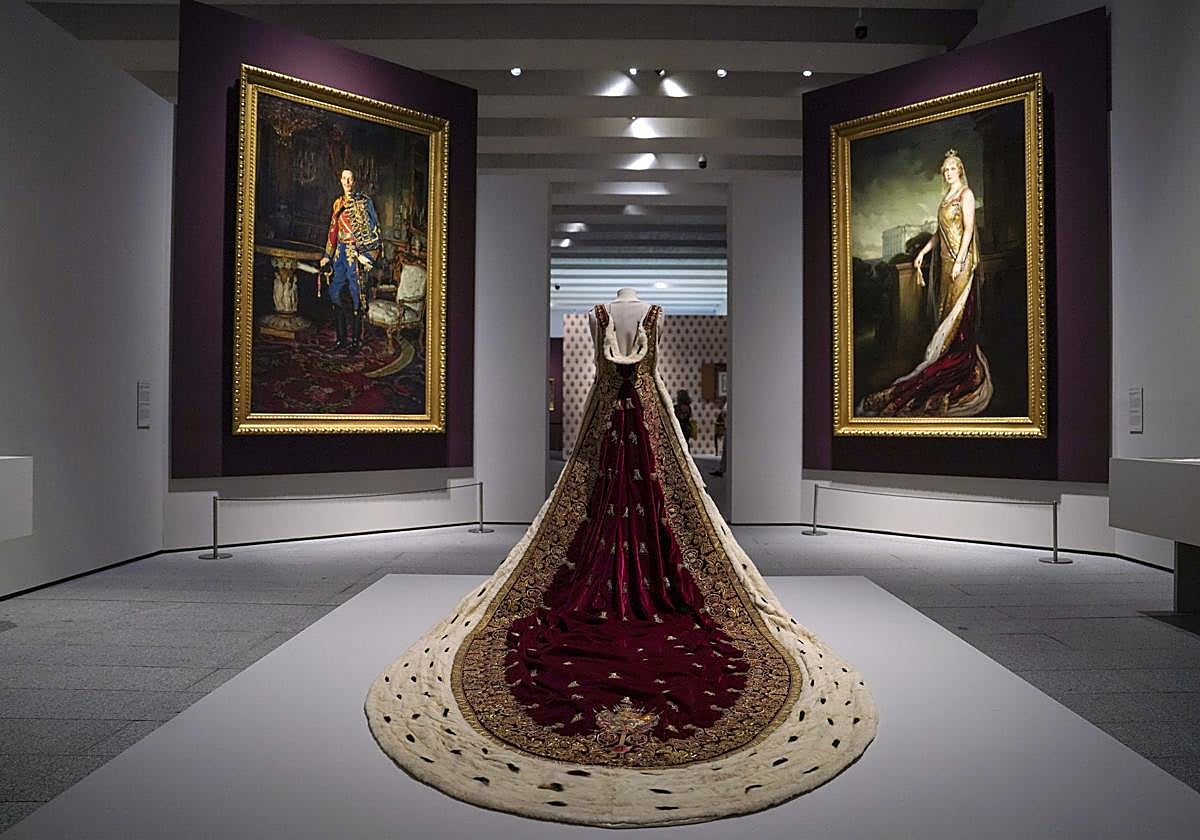
There are many stellar pieces in the exhibition, but the Fleur-de-Lis tiara stands out, a sumptuous gift from Alfonso XIII for their wedding, a marvellous creation by jeweller Ansorena. It is adorned with three fleur-de-lis made with diamonds set in platinum in the central part and both sides. The rest is formed with Louis XIV style motifs studded with brilliant and pink diamonds. It is displayed alongside a gallery of portraits, with busts by Benlliure, paintings by Philip Alexius László de Lombos, Sorolla, and other great artists of the time.
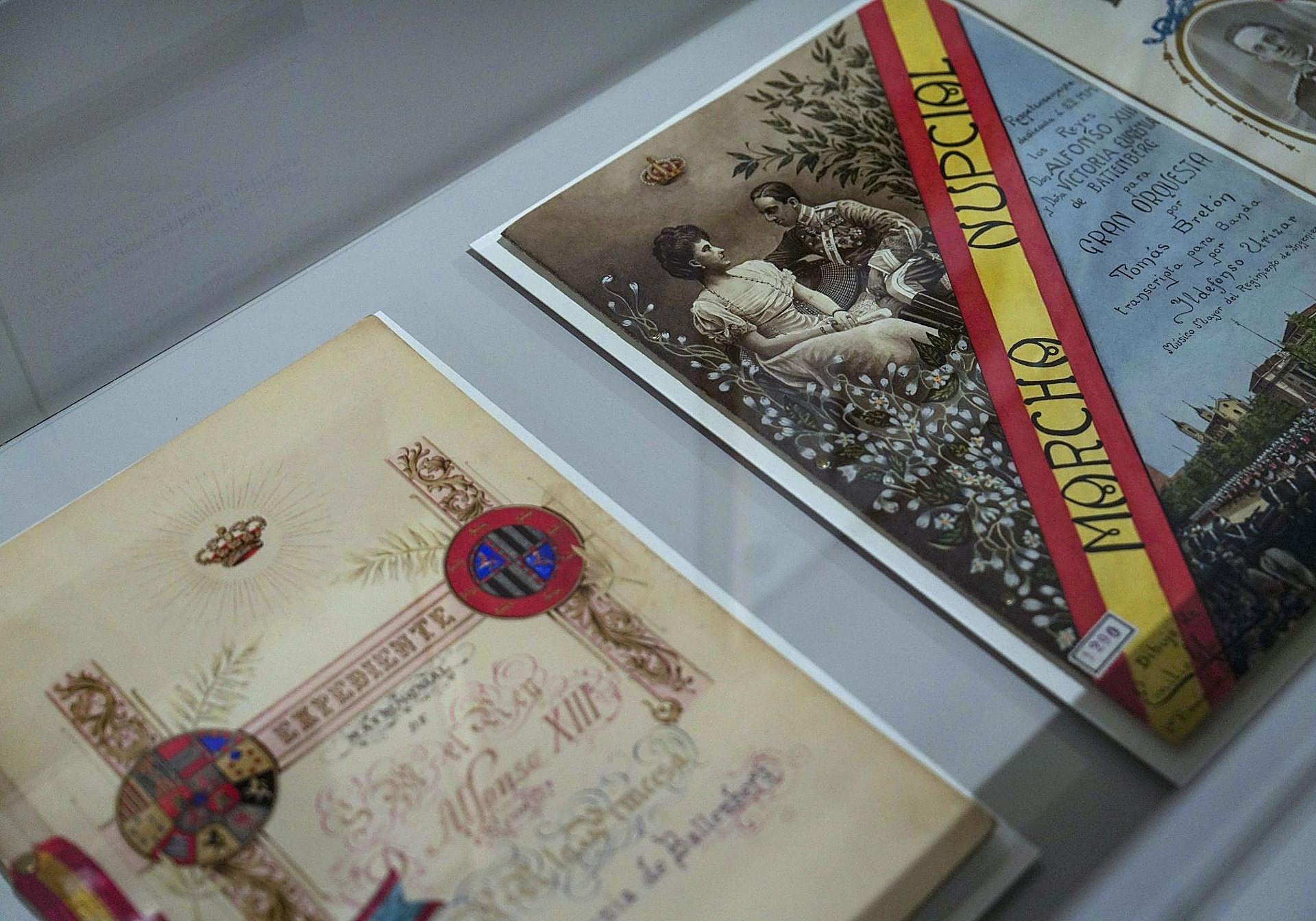
Also exhibited are the postcards she sent to Alfonso XII, wedding gifts, trousseau, and porcelain for the five o'clock tea - a custom she introduced to the Spanish court - books, items such as a gold and silver typewriter, a gramophone, her ceremonial velvet and ermine mantle that belonged to Isabel II and with which Ena opened the Cortes each year, and a superb bust of the royal couple with Alfonso XIII modelled in bronze and Ena sculpted in snowy marble by Mariano Benlliure.
The Royal Crown car, the carriage of the attack the couple suffered on their wedding day, May 31, 1906, is not in the exhibition. After the wedding, the kings headed to the Royal Palace of Madrid. The procession was violently interrupted at number 88 of Calle Mayor by a bomb hidden in a bouquet of flowers thrown from a balcony by anarchist Mateo Morral. The kings emerged unscathed from the assassination attempt that caused 24 deaths and many injuries.
The carriage from the attack can be visited on the Bourbon floor of the same royal gallery, free from the many damages it suffered. The Mahogany Car in which the queen travelled from the Ministry of the Navy to the Royal Palace before her wedding at the church of San Jerónimo el Real is on display.
Among the documentation revealed by the investigation is the letter that the Marquis of Villalobar sent to Queen Cristina, mother of Alfonso XIII, in which it is reported that the future queen could transmit haemophilia, a disease that only affects men and would not be named until 1912.
From Balmoral to the Royal Palace
Granddaughter of Queen Victoria, Ena was the second of four children of Prince Henry of Battenberg and Princess Beatrice of the United Kingdom and Ireland. She was born in the Scottish castle of Balmoral on October 24, 1887. She was baptised with the names Victoria, after her maternal grandmother; Eugenia, after her godmother, the Empress of France, Eugenia de Montijo; Julia, after her paternal grandmother, the Polish Countess Julia Hauke. To these names was added Ena, the Gaelic name for Eva, by which she was familiarly known and which she considered vulgar. "She was surprised to be called Ena, a name used in the family and considered not very regal," explain the curators.
She arrived in Madrid at the age of 18, in January 1906, to marry Alfonso XIII months later and left the Royal Palace a day after her husband, on April 15, 1931, following the proclamation of the Second Republic. Between 1934 and 1939, she returned to England and from 1942 made her residence at La Vieille Fontaine in Lausanne. She would not return to Spain until 1968, for the christening of her great-grandson and future king Felipe VI. She passed away in Lausanne on April 15, 1969. On April 25, 1985, her remains were transferred to the Pantheon of Kings at the Monastery of San Lorenzo de El Escorial.