A British Artist 'Crucifies' Trump in Basel
The sculpture 'Saint or Sinner' is the work of British artist Mason Storm
Beatriz Juez
Berlín
Tuesday, 4 November 2025, 19:35
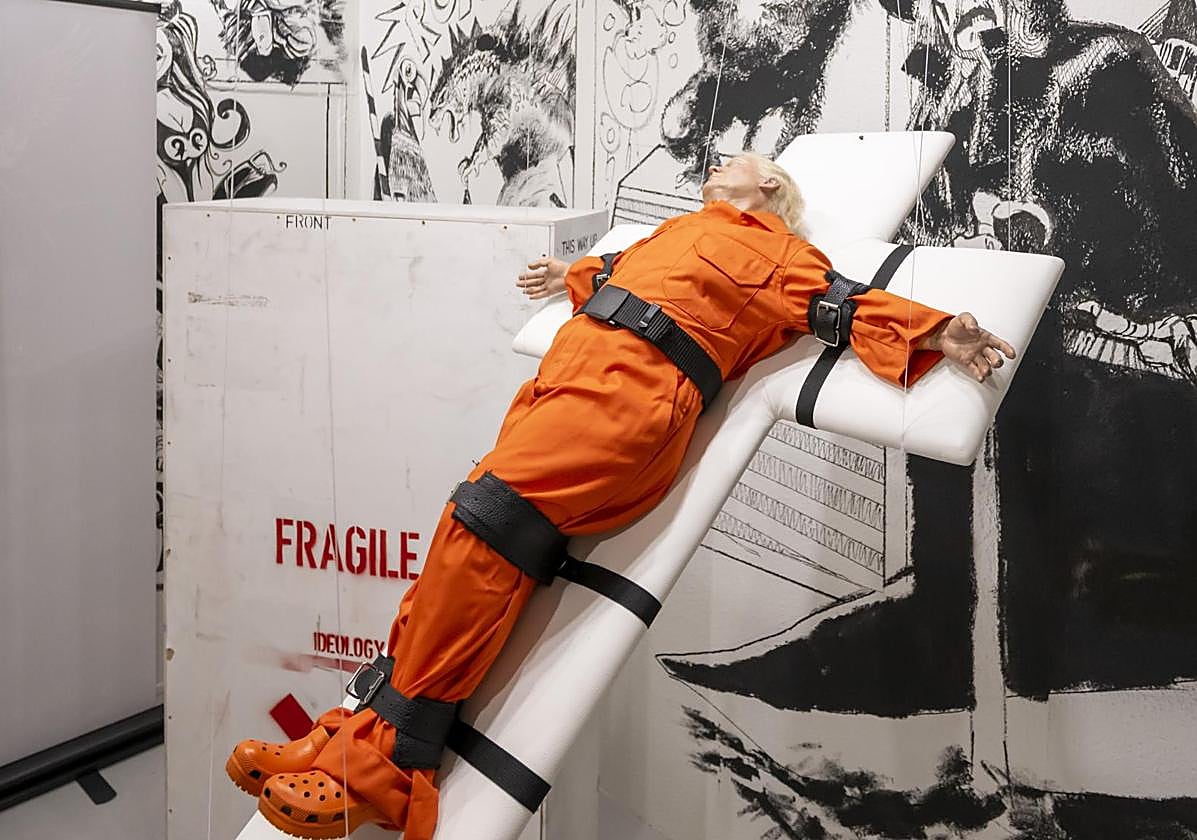
A sculpture of the United States President Donald Trump crucified, created by British artist Mason Storm, is causing controversy in the heart of Basel, Switzerland's cultural capital, and sparking much discussion beyond its borders.
The artwork realistically depicts Donald Trump. The president is portrayed disheveled, dressed in an orange prison uniform, and wearing orange Crocs sandals.
Trump is shown lying on a stretcher shaped like a white cross, with his arms, legs, and body strapped down to immobilize him. The stretcher resembles those used in judicial executions in the United States.
The occupant of the White House is depicted with his head tilted to one side and eyes closed, as if dead from a lethal injection or crucified like Jesus Christ.
The sculpture, titled 'Saint or Sinner', portrays Trump with Christian iconography as a modern saint or a condemned criminal, oscillating between veneration and condemnation, depending on one's interpretation.
Is Trump a saint or a sinner? Can he be both at the same time? The viewer becomes judge and jury in a hypothetical trial of the president. So far, Trump has not reacted to the controversial sculpture.
The artist, who has worn a mask since 2010 to conceal his identity and create mystery around his persona, does not provide an answer to the dilemma posed, leaving the viewer to decide whether to condemn or sanctify Trump.
Mason Storm, born in 1981 in London, never attended a traditional art school. Before pursuing art, he was a lawyer and security service provider, specializing in espionage and terrorism, according to his gallerist.
Storm began wearing a mask when he announced in 2010 that he would reveal the face of artist Banksy in an oil painting. This campaign was nothing more than a clever marketing strategy and it worked.
Initially, the 'Saint or Sinner' sculpture was scheduled to be displayed at Basel's SBB train station in September, but it was suspended for security reasons.
The Swiss gallery finally unveiled the sculpture on November 1st, All Saints' Day, in a commercial passage of the so-called Basler Kunstmeile, Basel's Art Mile. On this day, Catholics honor all saints, known and unknown, and many families visit cemeteries to pay respects to their loved ones' graves. The controversial sculpture will be on display in Basel for two weeks.
The Swiss gallerist deliberately hung Trump's work diagonally. "If it were horizontal, it would resemble a condemnation or execution too much, and if it were vertical, too much like a crucifixion. To avoid influencing public opinion, we opted for this neutral 45-degree position," explained Konrad Breznik, co-owner of the Gleis 4 gallery, to the Swiss television channel SRF.
Is it blasphemy or art? Is it merely a provocation as a publicity strategy, or is there something deeper behind this work? Is it in bad taste or a brilliant idea? The debate is open.
"Mason's work is considered controversial and provocative, but he never wants to provoke for the sake of provoking: there is always a reason behind each work," explains the gallerist on his website.
The Swiss gallery considers this work by Storm as "an ideal starting point for a conversation about art, politics, and the question of how we interpret images today."
"Storm combines the visual language of traditional iconographic painting with the candor of contemporary pop culture. The result is a work that raises questions about morality, religion, power, and social double standards in equal measure," explains the Gleis 4 Gallery in a podcast.
The sculpture, which has already been sold to an anonymous buyer, is protected against theft and vandalism. According to the gallery, it is equipped with an integrated GPS chip and sensors.
Trump supports the death penalty. The president resumed the execution of death row inmates for federal crimes after a 17-year moratorium. Thirteen people were executed at the federal level during his first term.
In 1989, Trump purchased a full-page ad in The New York Times calling for the death penalty for the 'Central Park Five'. These five youths, four black minors and one Latino, were wrongfully convicted of raping and nearly killing a young white woman jogging in New York's Central Park. Years later, they were proven innocent and exonerated of that crime.
In the United States, the death penalty is legal in 27 of the 50 states and at the federal level in both civil and military legal systems, while it is abolished in 23 other states, according to data from the non-profit organization Death Penalty Information Center (DPI).
The president signed a memorandum last September to allow the death penalty to be reinstated in Washington DC, the capital, in cases of murder. The District of Columbia, which has a unique legal status and is not considered a state, abolished the death penalty in 1981.