Kia PV5: The Brand Enters the Zero-Emission Commercial Vehicle Market
Juan Roig Valor
Monday, 1 December 2025, 12:05
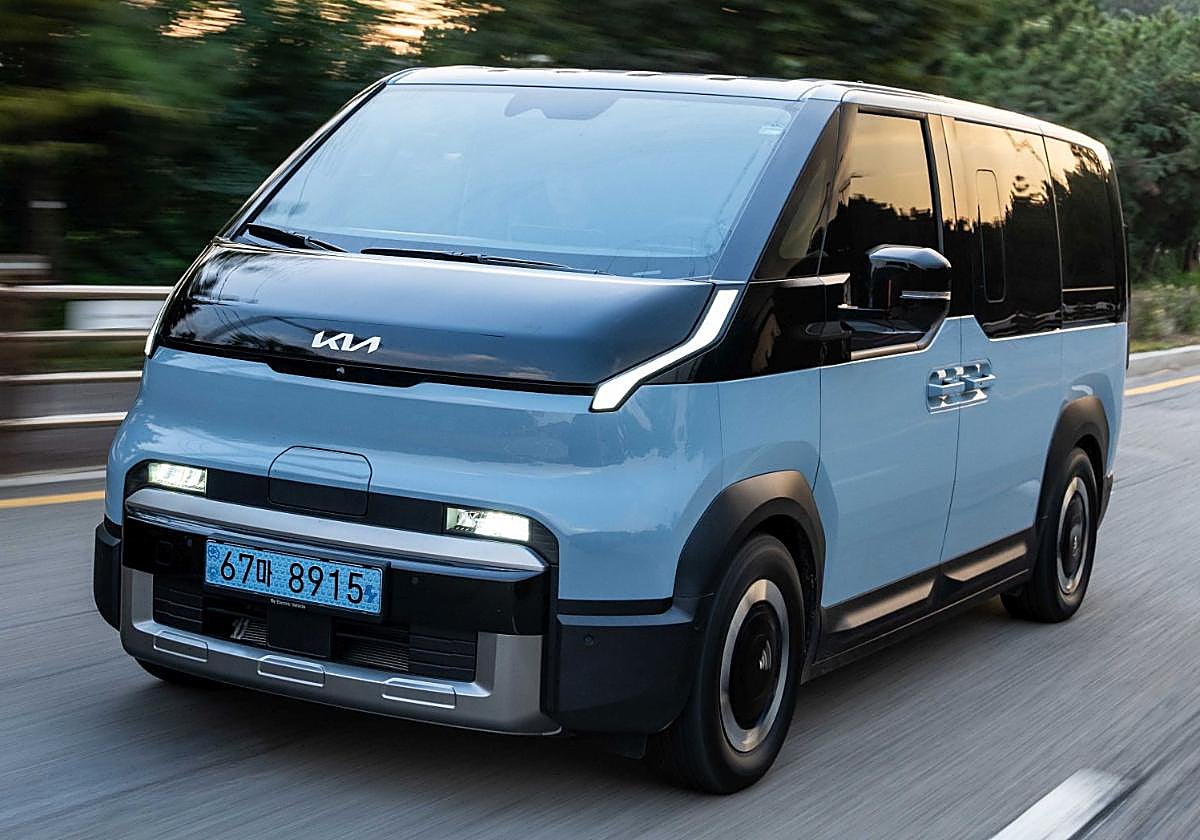
Kia has gone all out with the new PV5, an electric vehicle designed for both passenger transport and professional applications. Its strategy is paying off: the model has not only set a Guinness World Record by significantly exceeding its certified range of 416 kilometres, but it has also been named "Commercial Vehicle of the Year," highlighting its impact on the Spanish and European markets.
According to the Korean brand, the PV5 is the first step in an ambitious rollout in the electric industrial vehicle sector. Following the currently available version, specific variants will follow, such as a light truck, adaptations for people with reduced mobility, and even a base designed for future camper vans. The intention is for the PV5 to serve as a versatile platform to fully electrify commercial fleets.
The model is offered in two main configurations: Passenger, aimed at transporting people like an electric minivan, and Cargo, focused on work with only two seats and a vast cargo space.
For now, Kia only markets the long body version—4.695 metres—although a shorter 4.5-metre variant will arrive in 2026. Nevertheless, one of the PV5's great surprises is its aerodynamics: despite its size, it achieves a Cx coefficient of 0.286, better than the current Renault Clio, which significantly contributes to its efficiency.
Each version can be equipped with one of the two available engines—122 or 163 HP—always paired with different batteries. The entry-level option, with 51.5 kWh, allows for a range of between 291 and 295 kilometres depending on the variant, while the superior option, with 71.2 kWh, extends the range to 416 kilometres in the Cargo version.
In 2025, a third battery of 43.3 kWh will be added, with its range yet to be disclosed, although it will be around 230 kilometres. All can be recharged at 11 kW in alternating current—with the option of an onboard charger of 22 kW next year—and up to 150 kW in direct current, allowing a charge from 10% to 80% in less than half an hour. The PV5 also incorporates V2G and V2L technology, allowing energy to be returned to the grid or external devices to be powered.
Inside, the PV5 offers a technological design, dominated by two screens of 7.5 and 12.9 inches, and a level of finish that departs from the typical commercial vehicle. Space is one of its great strengths: in the Passenger version, the rear row offers unusual spaciousness and, from 2026, can be configured with seven seats. The boot reaches 1,330 litres, while the Cargo variant stands out even more, with a volume of up to 4.4 cubic metres and capacity for two Euro pallets.
On the road, the PV5 stands out for its refinement. The acoustic insulation is comparable to that of a passenger car, thanks to elements such as acoustic windows or lower absorption panels. The suspension maintains a balance between firmness and comfort, necessary to manage the weight of the load. Additionally, its specific E-GMP-S platform allows for a very tight turning radius of just 5.5 metres.
Official consumption ranges from 19 to 19.3 kWh/100 km depending on the engine, although in real conditions it may vary depending on weight and type of journey. Both the 122 and 163 HP versions reach 135 km/h and accelerate to 100 km/h in 12.8 and 10.6 seconds, respectively.
As for prices, the PV5 range starts at 18,397 euros for the Cargo version with a 51.5 kWh battery, a figure that includes discounts, the Moves Plan, and VAT deduction for companies. For passengers, prices start at 25,350 euros for the Essential model with the smaller battery, reaching up to 33,850 euros in the Elite version with the 71.2 kWh battery. Kia Spain expects to sell around 1,600 units in 2025, equally divided between Passenger and Cargo.
With a seven-year warranty—and eight for the battery—the KIA PV5 positions itself as one of the most ambitious commercial electric vehicles on the market, and an option to consider against the Volkswagen ID Buzz, although it has more compact dimensions than the latter.