Alicante Travels to Its Distant Past
'Cities of Light', the new exhibition at MARQ, showcases the various civilizations that passed through Tossal de Manises: Ákra Leuké, Lucentum, and Laqant, through a journey between archaeology and new technologies.
Adrián Mazón
Alicante
Friday, 20 December 2024, 19:51
Why does the coat of arms of Alicante have four letters? For some, they signify 'Akra Leuka Lucentum Alicante', while for others, it is 'Alicante Lucentum Lucentum Alicante'. The name Laqant is also present in some thoughts. These are the civilizations that precede the current city, all connected at Tossal de Manises.
Light also connects the concepts and names. Ancient sailors navigating the waters of old Alicante—from Tabarca and Santa Pola, or from the ancient Allon by Cabo de las Huertas—saw "luminous zones" over the land that jutted into the sea, corresponding to today's beaches of Albufereta and Almadraba, Postiguet, and the neighborhoods of Benalúa and Babel.
The new exhibition at the Provincial Archaeological Museum of Alicante (MARQ), 'Ákra Leuké, Lucentum, Laqant. Cities of Light. Ancient Alicante', discusses this. The institution, under the Alicante Provincial Council, highlights Alicante's past, dating back over 2,000 years.
The exhibition opened this Friday and will be available to locals and visitors until May 18. It explains the origins and civilizations that have passed through 'the best land in the world', as well as its expansion and the work the provincial institution has done to highlight this legacy since the second half of the 20th century.
These three premises are summarized in a video-documentary welcoming visitors to MARQ in its 'Waves over the Sea' space. Awareness of heritage and archaeological work offers an initial contact with the city's past, complemented by an initial display of texts and manuscripts from important thinkers and illustrious figures who, since the 18th century, have spoken of the vestiges contained in Tossal de Manises.
Among them are chronicles of the time, texts from the Count of Lumiares, and also from Figueras Pacheco. Many are "unpublished" and have never been shown to the public before. The Mediterranean Foundation is one of the institutions that has provided this legacy to complement a unique exhibition at the museum. Thus, it shows how more than 30 years ago, there was already talk in Alicante society about the existence of Lucentum in Albufereta and the Roman expansion to Benalúa.
This exhibition, 'Cities of Light', is also the largest in surface area that the museum has hosted to date. In addition to this space, the more than 661 pieces that make up the collection—from various museums and institutions—are distributed in the corridor connecting the three temporary rooms, and the MARQ library is added as an area narrating 'The Rescue from Oblivion'. It is there that the Alicante Provincial Council takes center stage by showcasing its fight to recover this history, highlighting the Alicante site for over 30 years.
First Room
Ákra Leuké
The first part of the corridor connecting the temporary rooms of MARQ introduces the viewer to the context of the exhibition and the origin of Alicante. "It talks about what has happened in the place," explains the museum director, Manuel Olcina. To this end, the 'Cities of Light' exhibition goes back to ancient Contestania, starting the discourse through materials from the era found in Albufereta.
Upon entering the first of the rooms, the digital reproduction of a bireme, a type of galley used for war, surprises; as well as the influence of the Punic world. All these elements prior to Carthage "appeared in Albufereta", scattered remains in Tossal de Manises where Ákra Leuké, the first civilization, settled. A relief map offers a panoramic view of the area.
It was between 235 and 231 BC when this first city was founded. Proof of this are the various coins—from museums like the MAN—that corroborate the dates, as they show a "period of splendor" by reproducing faces of important personalities on the currency. "They are unique specimens in the world", featured in this MARQ exhibition in Alicante.
The culture of this civilization "distinguishes it from the Iberian world". Various excavations in Lucentum have revealed that imports existed at that time. Multiple vessels and other elements appear as the viewer enters the room, with products from North Africa, Ibiza, and southern Italy.
This society, Ákra Leuké, proved ephemeral due to the devastation of war, which ravaged around 209 BC. Tossal de Manises suffered a "siege of blood and fire", explains Antonio Guilabert, another of the exhibition's curators. In fact, it was during the 2015 excavation campaign that charred body remains were found in the area. This war episode is reproduced before accessing the apse of this first room, where a strong dish is displayed: the tomb of a warrior found in Albufereta, along with inscriptions.
Second Room
Lucentum
After a century of abandonment of the ancient Ákra Leuké, the Roman civil wars hit the southeast of the peninsula. This narrative thread of ancient Alicante's history is exhibited in the second section of the MARQ corridor, alongside military materials that surprise the viewer. These include hoes and saws, among others, used to create camps each day during their expansion journeys.
Likewise, a change in the culture of this civilization is also noted, adopting utensils such as pots or pans. However, without ever losing their origin, the curators of the new MARQ exhibition emphasize. During this period, Tossal de Manises becomes a "military fort without urbanism", leaving aside the constitution of a city as the area was used to "monitor the coast".
It was later, taking advantage of the 'castellum', that the city, Lucentum, was founded. It is here that one enters the second of the temporary rooms of MARQ, which welcomes with various panels reflecting the neighboring cities of Ilici, Cartagena, or Allon. The Roman influence is seen in Tossal de Manises, centuries later, due to the activities found during excavations: economy, agriculture and livestock exploitation, and burials outside the city.
Other elements of vital importance for understanding have also been found in its remains, such as a bilge pump or copper ingots. In this room, one weighing up to 60 kilos is displayed. After this introduction, new technologies allow the recreation of Alicante's oldest past through 21 reproductions of characters created with artificial intelligence.
The tombstones found in ancient Lucentum have allowed the naming of the ancestors of the people of Alicante. These are shown on different screens, which reproduce life from 2,000 years ago. Each character has a different origin and social class, reflecting the diversity that inhabited Tossal de Manises. "There was a broad Roman society".
At the end of the room, the second of the apses presents the "domestic and social" religion that was present in the ancient city of Lucentum. Altars and sacrifices are the legacy left by its ancient inhabitants, along with a bronze hand for which researchers have various hypotheses about its origin, authorship, and ownership.
Third Room
Laqant
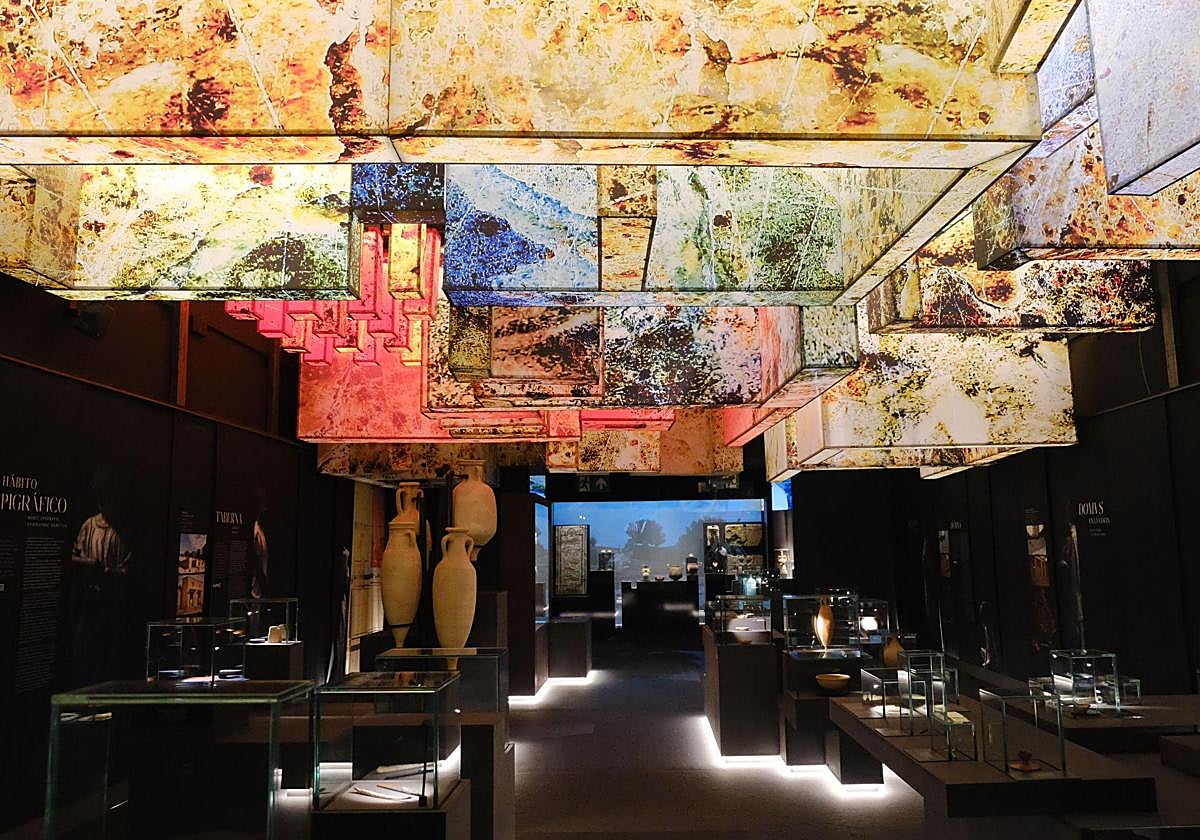
Roman administration was key in the development of this civilization settled on Alicante land. This is shown in the last section of the corridor, where the different bodies that made up the society of the time and how decisions were made are explained. Upon crossing the door that gives access to the third room, visitors are struck by the impressive ceiling designed by architect Ángel Rocamora, offering a vision of what the city of yesteryear was like.
For maximum understanding, the objects located throughout the room make "a nod" to the different parts of the site, such as taverns, domus, and baths, among many others. "When the city is founded, its inhabitants become, although they maintain their customs", regarding the Roman Empire.
As steps advance under the recreated villa, the city dissolves in reference to the entry into the Late Empire. It was there that the expansion and relocation to 'Baver', the current neighborhood of Babel closer to the Benalúa Sur district, emerged, which disappeared around the 6th century, "when the Visigoths defeated the Byzantines".
A large 16th-century map shows the different points of conquests and settlements in the municipal surroundings of the city of Alicante. Under the map, the exhibition presents Visigothic remains found in Albufereta, as well as others from the La Alcudia site in Elche. These reflect the existence of churches and basilicas in the ancient city during the era.
The apse of this room also depicts the conversion into Laqant, through an Islamic cemetery. It is in the ruins of the ancient Roman city where the urns were found, although inside "there is nothing", comment the exhibition's curators. One of the vessels found, exhibited in the museum, was subjected to Carbon 14 testing to determine its remains and corroborate this new settlement.
Fourth Room
'Rescue from Oblivion'
The MARQ Library becomes the last room of the 'Cities of Light' exhibition. Under the title 'Rescue from Oblivion', the remains of the destruction of the ancient cities that preceded present-day Alicante are shown. Two large murals accompany. The left one, a journey through the urban planning of the excavations of the Count of Lumiares; while the right one shows the recovery works of the Tossal de Manises site from 1994 to 1998.
This second serves as a tribute to all the workers who have maintained and continue to keep the current Lucentum alive, where it seems that "you enter and it is newly inaugurated" due to the excellent conservation work. Additionally, several tables crown the room.
On one of them appear the remains of the destroyed cities, on others the documentation used for the recovery of Tossal de Manises since 1984, with a motion from the Provincial Council Plenary—endorsed unanimously—to obtain the exploitation of the site to proceed with its enhancement. It is worth remembering that the State fenced it in 1983.
At the back of the library, current materials used to reconstruct the vestiges of Alicante's origin in this enclave located in the Albuferta neighborhood appear, which gives rise to the current city and whose memory is captured in its coat of arms: 'A L L A'. 'Ákra Leuké, Lucentum, Laqant. Cities of Light'.