The Conflict Between the RAE and Cervantes Intensifies in Arequipa
García Montero and Muñoz Machado Fail to Reconcile at the Spanish Language Festival, Setting the Stage for Further Clashes
Miguel Lorenci
Monday, 13 October 2025, 22:00
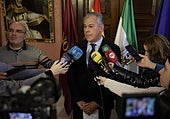
Would there be peace or more conflict? High expectations on Monday as the first joint appearance followed the recent tensions between the head of the Royal Spanish Academy (RAE), Santiago Muñoz Machado, and the director of the Cervantes Institute, Luis García Montero. However, the meeting only widened the gap between them. Their evident lack of harmony worsened, as there was neither a truce nor even artificial courtesy between García Montero and Muñoz Machado. Despite their previous statements about not discussing their differences, they did so openly.
The tension, verbal clashes, and insults between the two Spanish linguists echoed once again in the Andes, creating a charged atmosphere on the eve of the start of the 10th International Congress of the Spanish Language (CILE) in the volcanic city of Arequipa, Peru, a country also engulfed in a deep political crisis.
"I will not comment now (at Monday's press conference) nor during the congress on peripheral issues unrelated to it," said Muñoz Machado when asked about the differences and harsh words exchanged with García Montero in recent days.
"At Cervantes, we are here to collaborate with Arequipa and Peru to ensure the congress is successful. We can discuss our differences much later in Spain, once the Congress is over," he reiterated.
"We are very committed to the efforts made by Peru and its institutions, and I want the congress to be successful. There will be time to discuss not only the director of the Royal Academy but also his successor, who is closely linked to the statement the RAE made the other day," said García Montero, much to the astonishment of Muñoz Machado, who simply responded briefly: "no idea." Many then turned their attention to Juan Luis Cebrián, another veteran academic present in the room.
A Turbulent Peru
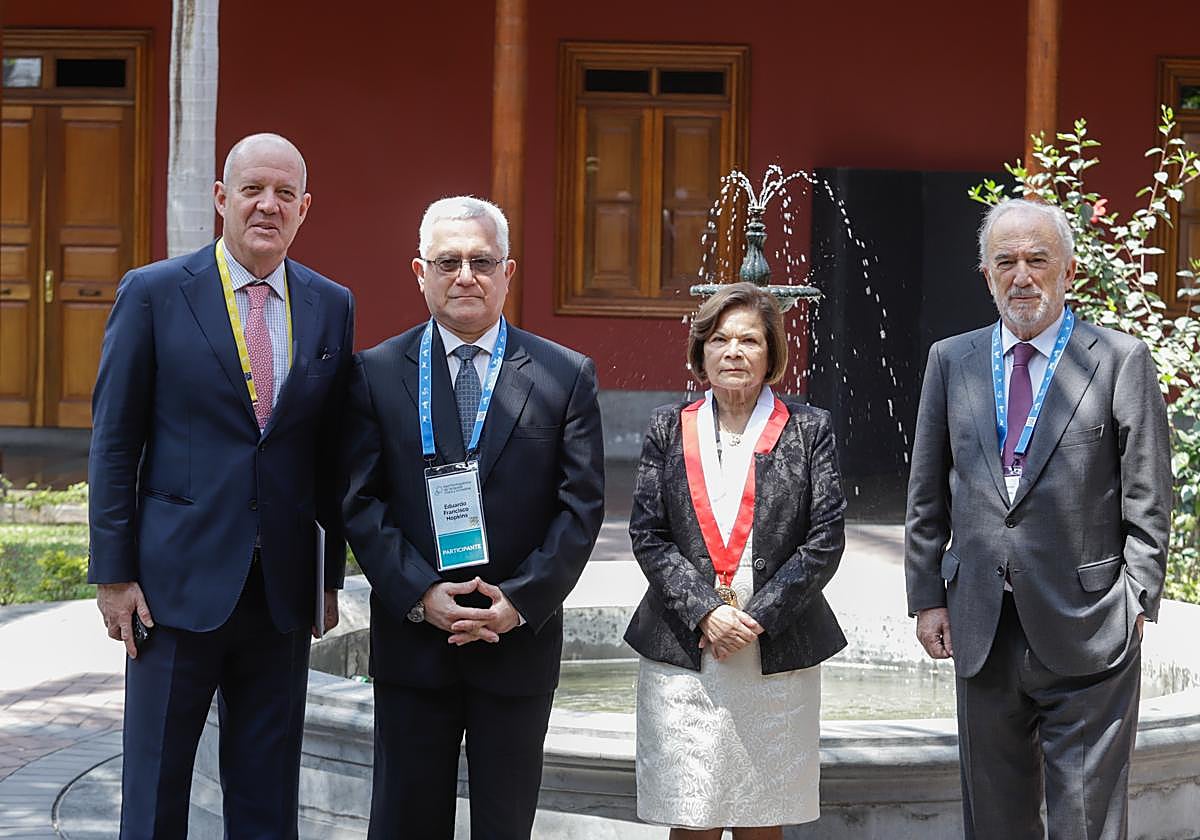
The triennial language festival brings together over 250 participants in Peru, including academics, writers, philologists, and intellectuals, to analyze the state of the Spanish language and its challenges: clarity, mestizaje, and artificial intelligence (AI). However, it was preceded by a bitter 'catfight' with accusations exchanged between two of the three organizing institutions: the RAE and the Cervantes Institute, alongside Asale, the Association of Academies.
The academic meeting is also marked by Peru's political instability, with its president until last Friday, the unpopular Dina Boluarte, being ousted by the Peruvian Congress for "permanent moral incapacity." There were some violent protests in Lima, but not in Arequipa.
In this context, King Felipe VI arrives this Wednesday in the white city, surrounded by imposing volcanoes, to deliver the solemn inaugural speech at the Municipal Theatre of Arequipa. José Jerí, who was swiftly appointed as Peru's interim president following Boluarte's ousting, is also expected to speak. Jerí, the former president of Congress until last week, is 38 years old and has a controversial biography, with a dismissed rape charge, involvement in several corruption cases, and allegations of pornography consumption. He is the eighth Peruvian president in a decade.
"When did Peru go wrong?" asks the young Zabalita in 'Conversation in The Cathedral,' the timeless novel by Mario Vargas Llosa, whom the CILE honors. "Perhaps it should be changed to 'until when did Peru go wrong?' joked a congressman. "All that's missing is for one of the three active volcanoes surrounding Arequipa to erupt," another quipped, referring to the towering fiery peaks of Chachani, Pichu Pichu, and Misti that encircle the Nobel Prize-winning Peruvian-Spanish author's hometown.
Long-standing Differences
The tension and disagreements between the leaders of the two main institutions overseeing the Spanish language are not new. However, they reached a boiling point when the director of Cervantes, Luis García Montero, stated that "the RAE is in the hands of an Administrative Law professor who manages business from his law firm for multimillion-dollar companies. That, personally, creates distances." The RAE responded with a stern statement expressing its "absolute rejection" of those "incomprehensible, unfortunate, untimely, and offensive" remarks, deemed an "attack" on Muñoz Machado.
The relationship between García Montero and Muñoz Machado, and consequently between the Ministry of Foreign Affairs, which funds the Cervantes Institute - 43% of its funds are self-generated, with the rest coming from the State Budget - and the RAE, an autonomous entity, albeit with 80% state funding, has never been cordial. This was evident at the CILE held in Córdoba (Argentina) in 2019 and in Cádiz in 2023, following the cancellation of the one planned for Arequipa in 2021 due to the critical political situation in the Andean country. Muñoz Machado acknowledged in Cádiz that there were "moments of tension" and "frictions," which he attributed to "certain ways of being" rather than the institutions themselves.