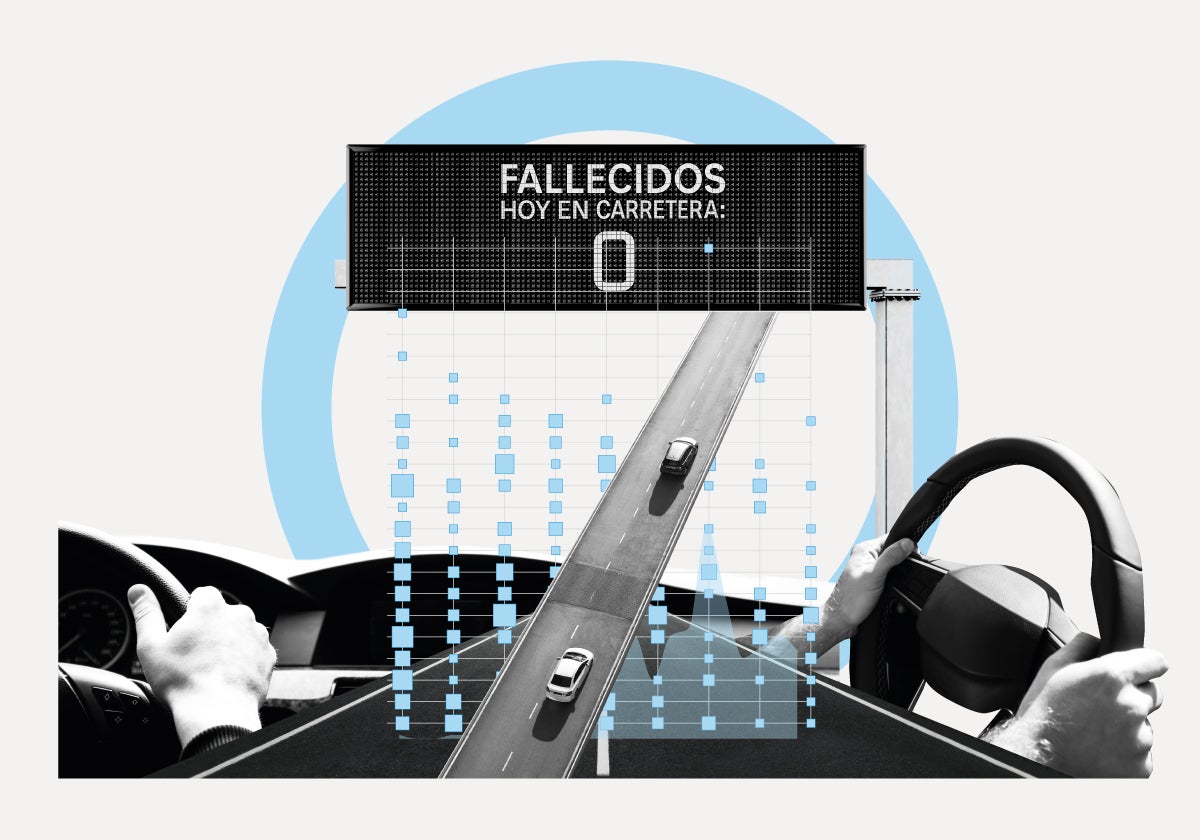
The Puzzle of 'White Days': 24 Days Without Fatalities on Spanish Roads in 2025
Every month this year has seen at least one day without fatal traffic accidents, even during periods of high mobility
Guillermo Villar
Madrid
Monday, 20 October 2025, 00:15
Parece que son pocos, pero en realidad son muchos, porque son los días en los que nadie ha perdido la vida en las carreteras españolas. 24 days with zero fatalities, 24 days without deadly accidents on interurban roads... a positive message that too often gets overshadowed by the grim statistics of traffic reports, where the focus is on the number of deaths and injuries. "In recent reports, increasing emphasis has been placed on these types of days, but we support highlighting them even more; it's worth exploring the best way to deepen this line of communication," says Álvaro Gómez, director of the National Road Safety Observatory of the General Directorate of Traffic (DGT).
Unfortunately, every month of the calendar has days with road fatalities. But this does not mean that every day of each month has mortal victims.
Therefore, it should not only be news -unfortunately- when there are fatalities. It should also be news when there are none. This is where the dimensions of white days in recent years compared to the early 21st century become apparent.
These are the two months with the most travel, giving more value to the white days. In July 2025, with 48.5 million, there were up to three days without deaths at the wheel. In August, with nearly 52 million movements (2.8% more than those recorded in the same month the previous year), there was one.
So far this year, February is the month with the most white days: five out of 28, which represents 18% of the total, a promising figure. If this percentage were extended to the entire year, we would have no less than 66 days without deadly accidents. February is followed by March (with four white days); January, May, and July (with three); April and June (with two) and August and September (one).
AUX STEP FOR JS
Gómez celebrates these '24 white days': "It shows that it is possible and should serve as motivation to make it a more frequent phenomenon," he points out. Those 24 days without deadly accidents in the first nine months of the year (in which there have been 363 million trips) are the same as in the same period of 2024 and two more than in 2023.
Nearly a third of those 'without' days (97) occurred during 2020 and 2021, marked by severe mobility restrictions due to the pandemic. In 2020 alone, the year of lockdown, long-distance travel (321 million) fell by 25% compared to the previous year, 106 million fewer road movements. This directly impacted a decrease in road accidents: 58 days without deaths, a record in the figures managed by Traffic.
When this distribution of white days is spread throughout the week from January to September, we also find that it was previously more difficult to ensure that all seven days of the week had at least one respite from these tragedies.
In 2025, the 'whitest' day was Monday (eight Mondays without deaths). In contrast, Thursday was the most tragic with fatalities every time. Since records began, Wednesday is the least tragic day (most white days).
It is noteworthy that in March there was a sequence of three consecutive days without mortal victims: the 17th, 18th, and 19th (Monday, Tuesday, Wednesday), the longest streak in five years. The maximum was in 2020. With the country paralysed by the health crisis, no more than five days without accidents were exceeded. Only during this period were road deaths avoided on weekends.
AUX STEP FOR JS
The statistics are approaching but still far from reaching 2050 with zero deaths, as aimed by the DGT, the European Commission, and even the United Nations. But it is not a utopia, as demonstrated by those 24 'without' days this year. It is a figure also valued by Aesleme, the association for the prevention of traffic victims. "We receive these white days as very hopeful news that leads us to conclude that the zero-victim goal is achievable. It's almost a month a year and should be given more visibility, we do so on our social networks," says Ana Carchenilla, Communication Director of Aesleme.
"We must not assume that mobility has to cause victims, because they can be avoided, we just have to each do our part: zero alcohol at the wheel, zero distractions, adjust speed to the limit, maintain infrastructures in good condition... The zero-victim goal is possible, but it depends on each of us," explains Carchenilla. And she adds: "We believe that the mobility of the future, which will leave less room for human error, will help us get closer and even achieve this goal."
In this same vein, Mar Garre, General Director of the Línea Directa Foundation, whose main focus is road safety, states: "It is a figure that, while positive, still places us far from our goal for 2050, which is to achieve zero victims in road accidents. Therefore, it is essential to continue working on awareness, training, and the adoption of measures that contribute to ending a problem that, each year, permanently affects the lives of thousands of people in our country. The latest regulations promoted by the DGT, such as the reduction of the alcohol limit or the modification of speed limits in the city, can help us advance in this challenge," opines Garre.