European Industry Halts Factories Amid Low Demand
Juan Roig Valor
Thursday, 9 October 2025, 07:05
When Porsche presented its stock market debut to investors three years ago, its CFO promised that their electric vehicles would sell better—and be more profitable—than their legendary combustion counterparts. Today, with a share price that has plummeted 49% since its debut, the German manufacturer announced it would halt plans to develop an electric SUV in the same segment as its most popular model, the Cayenne.
Porsche's symptoms, the luxury sports division of the Volkswagen Group, highlight the harsh reality facing the automotive sector in Europe: it is difficult to convince customers to make the leap to zero-emission mobility, a reality pushed by Brussels with the planned ban on combustion engines by 2035, costing billions in development and production changes for a market—the European one—that, although large, has less growth projection than others.
The first bets on electric models came in the upper market segments, with models like the Porsche Taycan—which sold more units than the iconic 911 in 2021—or the Mercedes-Benz EQS, with prices above 100,000 euros. The key, according to Porsche's then CFO, Lutz Meschke, was that "customers will be willing to pay more for them as it is new technology." This does not seem to have been fulfilled, and now manufacturers aim to balance their value with that of thermal vehicles.
The bulk of sales today is in the mainstream segments, with brands like Citroën, Renault, Dacia, Skoda, and Volkswagen offering zero-emission options. In fact, the latter is the best-selling brand in Europe, dethroning the market leader for years, Tesla. Volkswagen achieved this by making the design of its electric vehicles more conventional, with a broader range and software updates to address the issues of its first IDs. In August, they registered 16,000 electric vehicles, a notable 45% increase compared to 2024, but still too low a volume to avoid halting the factories producing these engines.
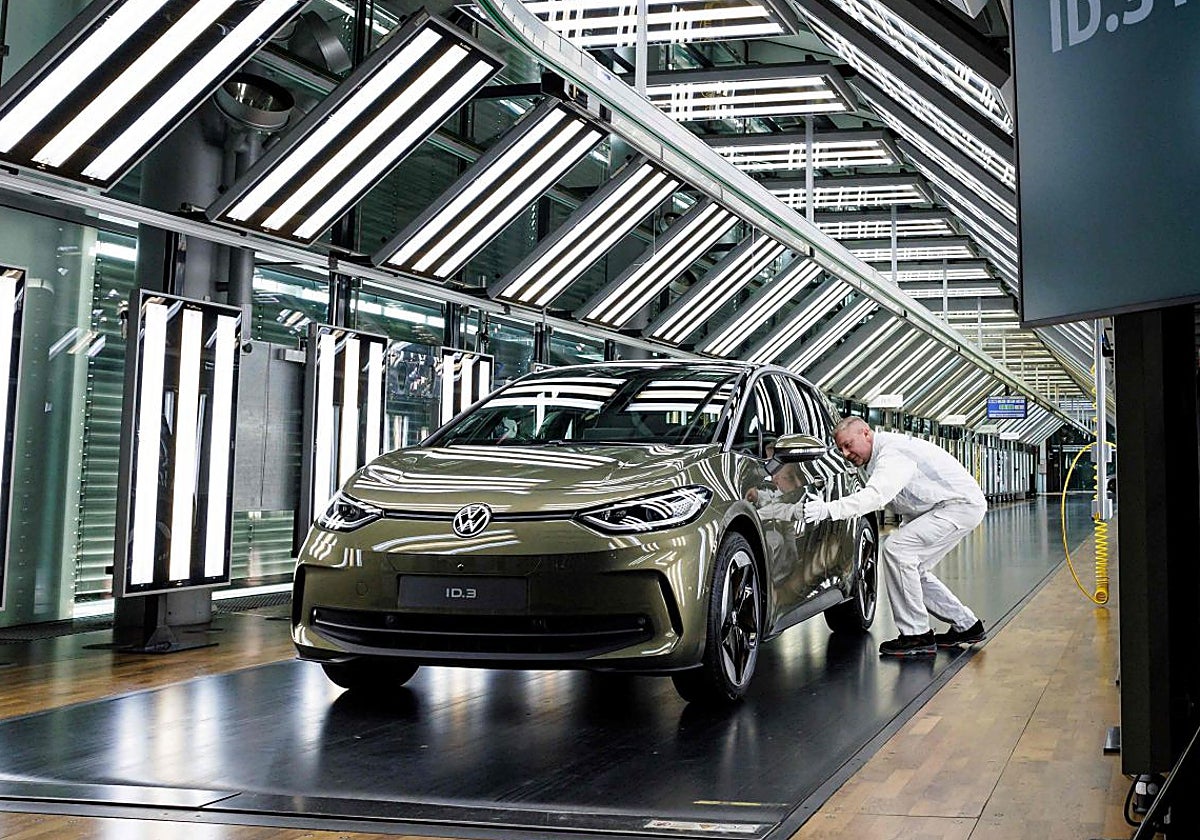
The German consortium has halted its German plants in Emden and Zwickau this week, where the ID.4, ID.7, Cupra Born, and Audi Q4 E-Tron are currently produced. According to Bloomberg, this is due to excess capacity faced by the manufacturer caused by low demand for these models. Since these plants only produce zero-emission cars, they are particularly vulnerable to fluctuations in consumer appetites, and it is not the first time Zwickau has stopped its assembly lines, and Dresden, which also manufactured the ID.3, no longer assembles vehicles.
But it is not only Europe's largest car manufacturer; the second, Stellantis, has also been forced to review its production rates due to excess inventory. Specifically, the Franco-Italian group—parent of brands like Peugeot, Fiat, Opel, or Citroën—announced it would halt six factories in the Old Continent, two of which are in Spain. Specifically, they are in Poissy (France), Pomigliano (Italy), Tychy (Poland), and Eisenach (Germany), as well as in Madrid and Zaragoza. From these come the Citroën C4, Opel Corsa, Peugeot 208, and Lancia Ypsilon, in electric and combustion versions. According to consortium executives, "the production pace of some plants is being adjusted to manage inventories more efficiently before the end of the year." Stellantis continues to deal with the consequences of the management of its former CEO, Carlos Tavares, who abruptly left the company at the end of 2024 after clashing with the Board of Directors. In the first half of the year, it reported net losses worth 2.24 billion euros, compared to the 5.647 billion in positive in 2024.
Overcapacity amid timid demand also affects other manufacturers facing a critical situation, such as Nissan. The Japanese company, which tried to save face by merging with Honda late last year in an operation that proved unsuccessful, reported losses of about 4.6 billion euros. With the arrival of its new CEO, Mexican Iván Espinosa, they announced they would close seven plants worldwide, two of them in Japan. Their future in Europe depends on the commercial success of the new electric Leaf and Micra, but the company is considering an alliance with Dongfeng—their partner in China—which would allow them access to Europe without facing Brussels' tariffs.
Suppliers at Risk
The crisis among manufacturers, who have taken precautionary measures and implemented cost-saving plans, also affects their component suppliers. In Germany, two of the largest, Bosch and ZF, announced they would cut 13,000 and 7,000 jobs in their companies over the next five years.
These cuts represent just 5% of what the European industry lobby, Clepa, estimates. In a report, they announced that around 20% of jobs could disappear, a total of 350,000 positions.