"ChatGPT is Too Dumb for Now"
"Success is Annoying," says the World's Most Read French Author, who Writes about Child Abductions in Ukraine / Translated into 50 Languages, he has Sold Over 50 Million Copies of the 25 Novels he has Published
Miguel Lorenci
Madrid
Sunday, 27 October 2024, 00:35
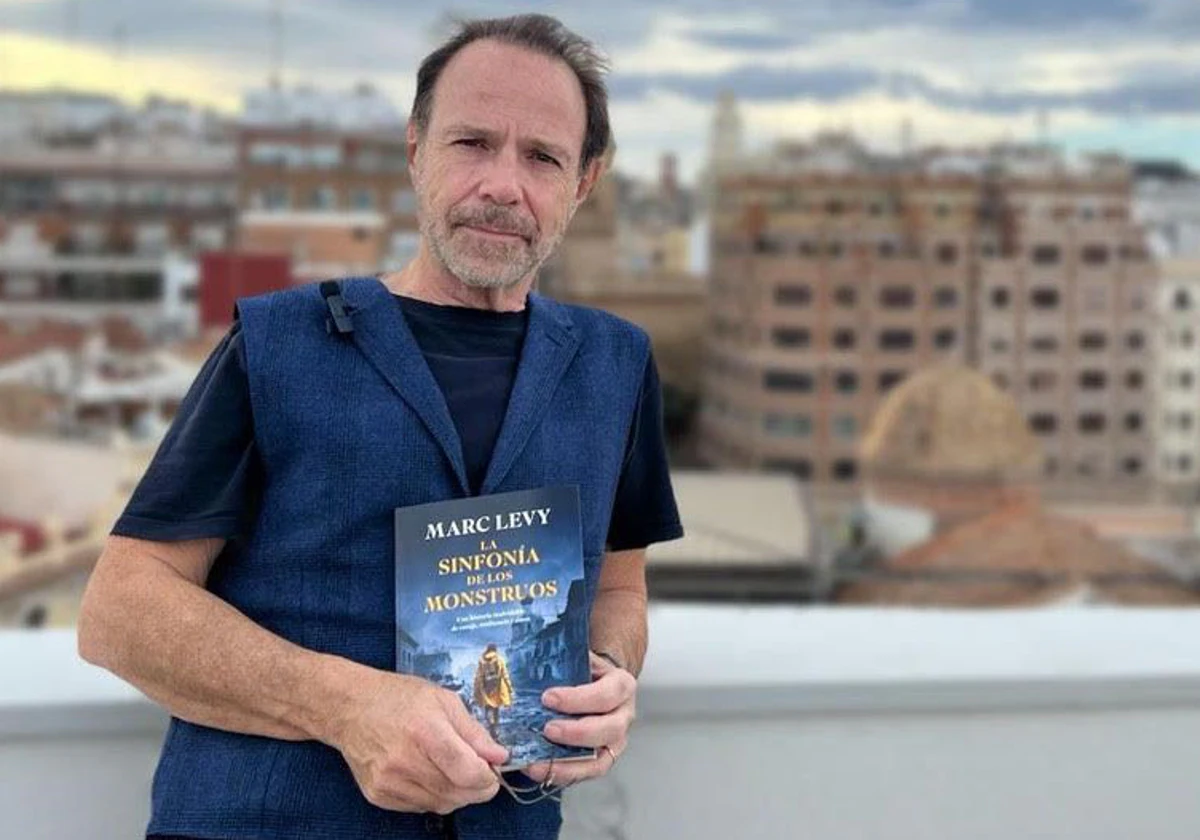
Marc Levy (Boulogne-Billancourt, 1961) published his first novel in 2000, a story intended for his son. His surroundings encouraged the former businessman to send it to a publisher. 'If Only It Were True' was an immediate success, and Steven Spielberg adapted it into a film. Since then, Levy has published a book every year. Up to 25 novels have topped the sales charts in France and other countries. Translated into 50 languages and with over 50 million copies sold, he is the most read living French author in the world. He publishes 'The Symphony of Monsters' in Spain (HarperCollins), which explores the mass abductions of Ukrainian children.
-It is darker than your previous books and inspired by a tragic current event. Do you change your style on purpose?
-No. I have changed universes, themes, and even genres many times. I never wanted to pigeonhole myself. I have written adventure, political, historical novels, comedies, and thrillers. I do not premeditate. I write about the topic that moves me at each moment.
-Does the story come to the author, or vice versa?
-The trilogy of 'The Nine' are already very political novels that say a lot about what is happening in the world and political corruption. In the last installment, 'Noa', I mention the invasion of Ukraine before it happened, after publishing the book. When I learned about the systematic deportation program of Ukrainian children by Putin's Russia, I felt the urgency to address the issue.
-Did you want to commit politically to denounce it?
-I have always tried to address serious issues without taking myself too seriously. It can be done from a perspective different from gravity. It is often the best way to captivate readers. 'The Symphony of Monsters' is not a documentary about the abduction of Ukrainian children. It is an adventure and love story about a kid who will do everything possible to escape, a teenager fighting to find her younger brother, and a mother who will do the same to recover her two children. But above all, it is the story of my characters through the great History.
-Are they ordinary characters in extraordinary situations?
-That's right. They are people who are forcibly immersed in an extraordinary situation that overwhelms them and who reveal themselves in an extraordinary way.
-The search for identity and love, recurring themes in your books, do they help sell more?
-It is not so much the search for roots that is at the heart of my novels. It is the question of identity. I make the distinction because identity is not always in the past. It is also in how you assume who you are, your social origin, your sexuality, your tastes, your personality... All this is part of the identity search, and sometimes it is more enriching and liberating than knowing who you descend from. Love is not because it sells more. Without love, for me, it lacks interest. I do not believe there is a painting, a sculpture, a photograph, a work, or a dance step worth sharing without love. Perhaps administrative forms. It is impossible to spend one or two years writing a story that is not imbued with love. I cannot conceive it any other way.
-Is becoming rich and famous dangerous?
-There are no famous writers. It is a mild form of celebrity. They know your name, but not your face. So there is no danger. For much of my life, I had no money, which has never been my driving force. I have always been driven by creation, imagination. I am an epicurean and very aware of the privilege of living from my pen. But I am not attracted to luxury. I am much happier in a small 'bistrot' than in a Michelin-starred restaurant.
-Do you have a good relationship with critics?
-Criticism has changed a lot. At the beginning of my career, the reviews were very harsh because success annoys. Today it is different, but I have always been indifferent. Critics used to gain notoriety by speaking ill of books. Today they only talk about the ones they like, which is much better.
-Some writers often have help. Does your publisher provide staff for your historical research, or do you use ChatGPT?
-No! ChatGPT is too dumb for now. It may change, but today it is not capable of finding anything. It extracts information from the Internet, which is full of errors. I research for a very simple reason: 9 out of 10 times you find something you were not looking for. If you outsource the research, you miss those details that can change your story. A writer researches to learn. If a character is a luthier, you research the profession to speak about it credibly. The important thing is to digest and assimilate the information. Research involves meeting with specialists to ask questions. This profession requires a lot of observation and listening. And that cannot be outsourced.
-Do you fear the blank page? Does lack of inspiration paralyze you?
-It depends on what we mean by blank page, which needs to be demystified. It is part of the daily life of all writers. Lack of inspiration is another thing. There is no writer who sits at their desk and already knows the 350 pages of their novel. 'And now what do I tell? How do I untie this knot,' you ask yourself. For many, that is an excuse to stop working. But in reality, it is not that you are blocked, it is that it is 'cooking'. Like in so many professions, there are moments of waiting, like the cook who waits for the dough to rise. For a writer, it is the same. Sometimes you spend three or four hours staring at the screen or thinking about how to move the story forward. The fear of the blank page is more related to the lack of inspiration, which is terrifying.
-Which Spanish authors do you prefer?
-Jorge Semprún and Carlos Ruiz Zafón. I love their works. And of course, Cervantes.
-Do you know Spain well?
-Especially Madrid, which I visit often. It is the only city where I could live besides New York. It has a unique mix of people and an air of life and culture that fascinates me.
-Is that contact with your readers important to you?
-It is fundamental. In our profession, we do not work in front of the public, as singers or actors do. We write alone. That is why meetings with readers are important; they are the only opportunity to interact and escape the solitude of the creative process.