Caution When Seeing This Sign on the Back of a Vehicle
Juan Roig Valor
Thursday, 29 May 2025, 13:05
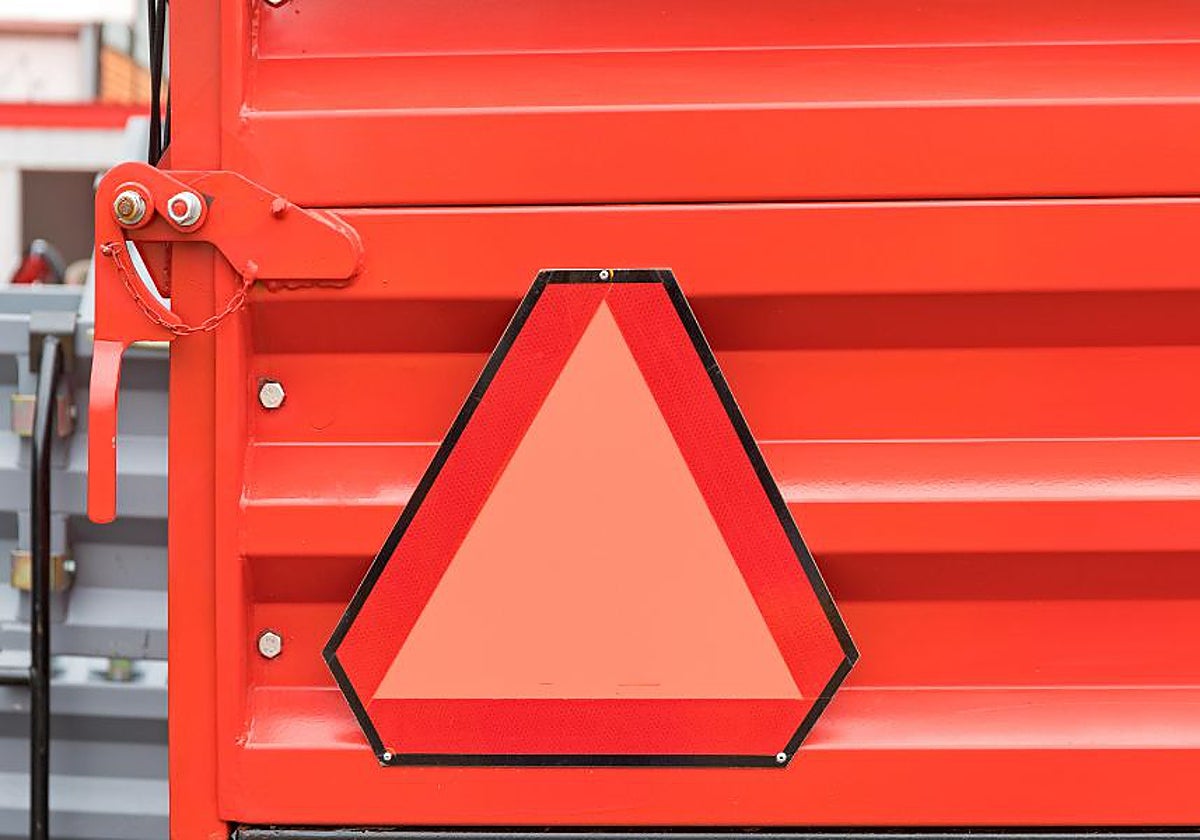
A warning sign, rarely seen on roads, was published by the Directorate-General for Traffic in their tests yesterday. The red triangle with double sides is placed on the back of a vehicle and is mandatory for vehicles that meet this characteristic.
Officially known as V5, the reflective triangle indicates that the vehicle carrying it cannot exceed 40 km/h. Generally, they are not often seen on roads, but if it is agricultural or construction machinery, it is likely to carry one.
This helps drivers anticipate the speed of other road users, adjust their driving, and avoid accidents. The V5 sign is not the only one that has started appearing on Spanish roads; several new road markings have appeared over the last five years. Given that for most drivers, it has been more than 10 years since they took the theoretical driving test, it is normal that they do not know their purpose.
The Ministry of Transport's Twitter account states that "the goal is to test the effectiveness of the markings and the degree of perception and understanding by drivers." Therefore, their application is limited to certain specific areas and they are not particularly well advertised.
An example of this is school zones, where white and yellow wavy lines indicate precisely that, and establish a speed limit of 20 km/h, as well as the need to exercise extreme caution, as a small child may cross the road at any moment.
Many of the new signs appearing in cities are the responsibility of their City Council – such is the case with the school streets in Madrid – but others are advancements by the Ministry of Transport to combat the increasing road accident rate this year.
An example of this is the 'dragon's teeth', present on some roads in Zaragoza and Burgos, as well as on interurban roads in Guadalajara (N-320), Segovia (N-110), and Valencia (N-330). These are parallel triangles on the edges of the lane, whose mission is to indicate that one is entering an urban area.
The triangles narrow as the population approaches, creating the optical illusion of a narrower road, prompting drivers to slow down to better control the vehicle.
These attempts to psychologically limit speed are also applied in two road signs visible around Spain. One of them is the red line dividing two lanes in opposite directions. This replaces what would be two continuous lines separating them and highlights the high accident rate of that section.
They can already be found, for example, in areas near Benidorm and Malaga, marking places where overtaking is prohibited and with a high influx of tourists during peak season, where alcohol consumption and unfamiliar roads may increase the risk of accidents.